Cell-saving drugs could reduce brain damage after stroke
12 Apr 2014
Long-term brain damage caused by stroke could be reduced by saving cells called pericytes that control blood flow in capillaries, reports a new study led by University College London (UCL).
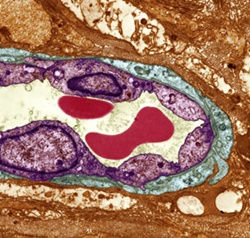 Until now, many scientists believed that blood flow within the brain was solely controlled by changes in the diameter of arterioles, blood vessels that branch out from arteries into smaller capillaries.
The latest research reveals that the brain's blood supply is in fact chiefly controlled by the narrowing or widening of capillaries as pericytes tighten or loosen around them.
The study, published in Nature, shows not only that pericytes are the main regulator of blood flow to the brain, but also that they tighten and die around capillaries after stroke.
This significantly impairs blood flow in the long term, causing lasting damage to brain cells. The team of scientists from UCL, Oxford University and the University of Copenhagen showed that certain chemicals could halve pericyte death from simulated stroke in the lab, and hope to develop these into drugs to treat stroke victims.
''At present, clinicians can remove clots blocking blood flow to the brain if stroke patients reach hospital early enough,'' explains Professor David Attwell of UCL's Department of Neuroscience, Physiology & Pharmacology, who led the study. ''However, the capillary constriction produced by pericytes may, by restricting the blood supply for a long time, cause further damage to nerve cells even after the clot is removed. Our latest research suggests that devising drugs to prevent capillary constriction may offer new therapies for reducing the disability caused by stroke.''
''This discovery offers radically new treatment approaches for stroke,'' says study co-author Professor Alastair Buchan, dean of medicine and Head of the Medical Sciences Division at Oxford University. ''Importantly, we should now be able to identify drugs that target these cells. If we are able to prevent pericytes from dying, it should help restore blood flow in the brain to normal and prevent the ongoing slow damage we see after a stroke which causes so much neurological disability in our patients.''
The new research also gives insight into the mechanisms underlying the use of functional magnetic resonance imaging to detect blood flow changes in the brain.
''Functional imaging allows us to see the activity of nerve cells within the human brain but until now we didn't quite know what we were looking at,'' explains study co-author Professor Martin Lauritzen, of the University of Copenhagen.
''We have shown that pericytes initiate the increase in blood flow seen when nerve cells become active, so we now know that functional imaging signals are caused by a pericyte-mediated increase of capillary diameter. Knowing exactly what functional imaging shows will help us to better understand and interpret what we see.''