Scientists design protein to prevent prostate cancer cell growth
30 Jan 2014
Researchers are creating a ''designer'' protein that could be effective at treating prostate cancer when other therapies fail.
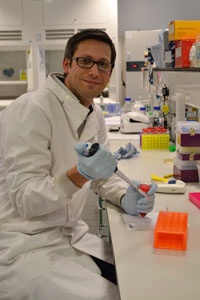 In laboratory tests, the protein hindered the growth of cancer cells even in conditions where conventional therapies are ineffective.
The researchers, from Imperial College London and the University of Essex, hope to develop the protein into a treatment that could be trialled in patients within five years.
The findings were published today in the journal Oncotarget.
Prostate cancer is the most common type of cancer in men. Around 37,000 UK men are diagnosed with the disease each year. Many prostate cancers develop very slowly, but in a small proportion of cases the cancer grows more quickly and spreads to other areas of the body, sometimes proving fatal.
Prostate cancers are only able to grow when they are exposed to male hormones such as testosterone. These hormones bring about their effects by binding to specific receptors, which are specialised proteins which act like switches to control tumour growth.
Many existing therapies target these receptors, yet after an average of two years the cancer becomes resistant to treatment. In this phase, hormones continue to drive the growth of cancer cells.
In this new study, the researchers have designed a new protein which blocks the hormone receptors and consequently stops prostate cancer cells from growing in the laboratory. The therapy was successful even in circumstances that led to the failure of conventional treatments.
Dr Greg Brooke, from the School of Biological Sciences at Essex, says, ''So far, the research has only been carried out in prostate cancer cells in the laboratory. These proof of principle experiments are really promising, but more work is needed before these therapies are ready for clinical trials. The next step is to continue research in cell models to refine the therapy into something that is specific, potent and easy to deliver.
''It's exciting to think that this research could offer new hope for men with advanced prostate cancer.''
Dr Charlotte Bevan, from the Department of Surgery and Cancer at Imperial College London, says, ''Eleven thousand men die from prostate cancer each year in the UK. Existing treatments are good at first but frequently fail after a couple of years. Once the cancer moves to the more aggressive stage, there are few therapies available.
''Our team is seeking to design a new therapy that will help patients once the other ones have failed.''