Genetic landscape of common brain tumours holds key to personalized treatment
By By Bill Hathaway | 29 Jan 2013
Nearly the entire genetic landscape of the most common form of brain tumour can be explained by abnormalities in just five genes, an international team of researchers led by Yale School of Medicine scientists report online in the 24 January edition of the journal Science.
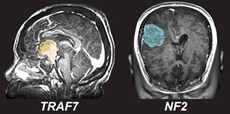 |
| Brain tumours called meningiomas tend to be benign. A Yale study shows that tumours associated with mutations in NF2 genes have a greater chance of becoming cancerous and form on the hemispheres of the brain, while those with non-NF2 mutations such as TRAF7 form near the base of the skull, a maybe good candidates for targeted chemotherapy rather than surgery. |
Knowledge of the genomic profile of the tumours and their location in the brain make it possible for the first time to develop personalised medical therapies for meningiomas, which currently are only managed surgically.
Meningioma tumours affect about 170,000 patients in the United States. They are usually benign but can turn malignant in about 10 per cent of cases. Even non-cancerous tumours can require surgery if they affect the surrounding brain tissue and disrupt neurological functions.
Approximately half of the tumours have already been linked to a mutation or deletion of a gene called neurofibromin 2, or NF2. The origins of the rest of the meningiomas had remained a mystery.
The Yale team conducted genomic analyses of 300 meningiomas and found four new genetic suspects, each of which yields clues to the origins and treatment of the condition. Tumours mutated with each of these genes tend to be located in different areas of the brain, which can indicate how likely they are to become malignant.
''Combining knowledge of these mutations with the location of tumour growth has direct clinical relevance and opens the door for personalised therapies,'' said Dr. Murat Gunel, the Nixdorff-German Professor of Neurosurgery, professor of genetics and of neurobiology, and senior author of the study. Gunel is also a member of Yale Cancer Center's Genetics and Genomics Research Program.