Scientists decode brain waves to eavesdrop on what we hear
By By Robert Sanders | 03 Feb 2012
These scientists have succeeded in decoding electrical activity in the brain's temporal lobe – the seat of the auditory system – as a person listens to normal conversation. Based on this correlation between sound and brain activity, they then were able to predict the words the person had heard solely from the temporal lobe activity.
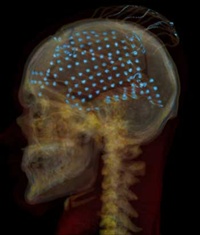 |
| An X-ray CT scan of the head of one of the volunteers, showing electrodes distributed over the brain's temporal lobe, where sounds are processed. Credit: Adeen Flinker, UC Berkeley |
''This research is based on sounds a person actually hears, but to use it for reconstructing imagined conversations, these principles would have to apply to someone's internal verbalisations,'' cautioned first author Brian N. Pasley, a post-doctoral researcher in the centre. ''There is some evidence that hearing the sound and imagining the sound activate similar areas of the brain. If you can understand the relationship well enough between the brain recordings and sound, you could either synthesize the actual sound a person is thinking, or just write out the words with a type of interface device.''
''This is huge for patients who have damage to their speech mechanisms because of a stroke or Lou Gehrig's disease and can't speak,'' said co-author Robert Knight, a UC Berkeley professor of psychology and neuroscience. ''If you could eventually reconstruct imagined conversations from brain activity, thousands of people could benefit.''
In addition to the potential for expanding the communication ability of the severely disabled, he noted, the research also ''is telling us a lot about how the brain in normal people represents and processes speech sounds.''
Pasley and his colleagues at UC Berkeley, UC San Francisco, University of Maryland and The Johns Hopkins University report their findings Jan. 31 in the open-access journal PLoS Biology.
Help from epilepsy patients
They enlisted the help of people undergoing brain surgery to determine the location of intractable seizures so that the area can be removed in a second surgery.