South Korea’s SK On and Ford Motor to End U.S. Battery Joint Venture
By Cygnus | 11 Dec 2025
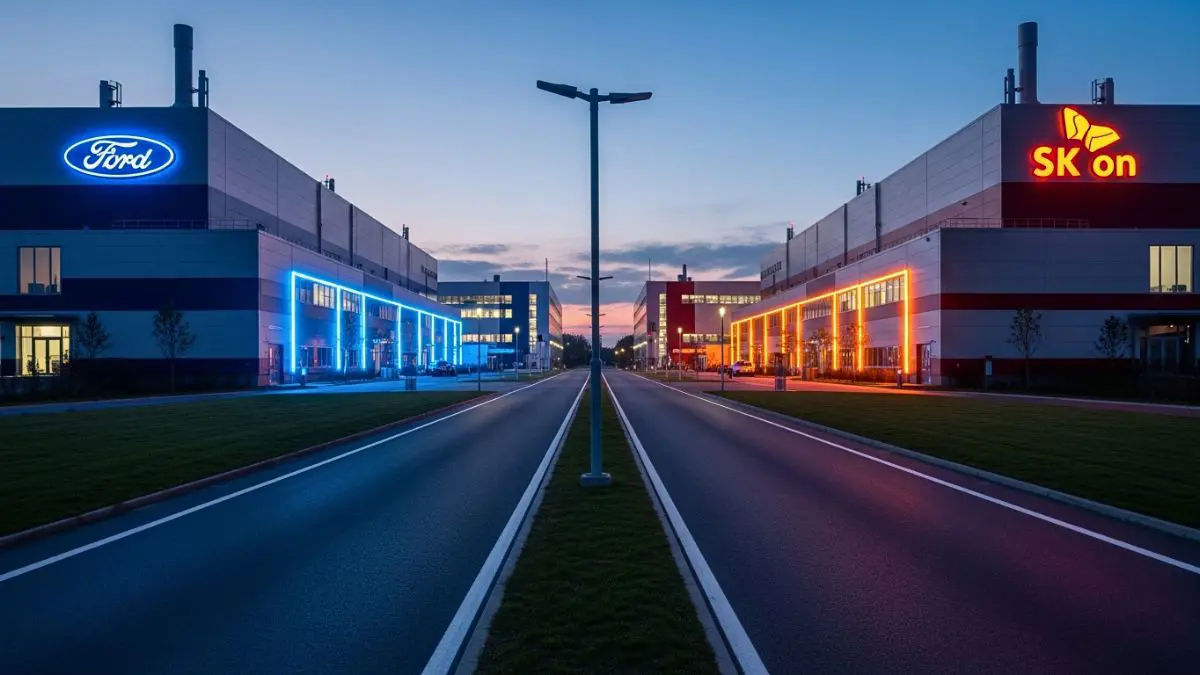
South Korean battery manufacturer SK On and U.S. automaker Ford Motor have announced they will wind down their massive joint venture, BlueOval SK, effectively ending their partnership on major U.S. battery production projects. The decision marks a significant strategic pivot, dissolving the alliance formed just three years ago to accelerate EV manufacturing in the United States.
SK On, a subsidiary of SK Innovation, confirmed that both firms have agreed to separate operations to better align with changing market dynamics. Under the new arrangement, the assets of the joint venture—originally valued at $11.4 billion—will be divided between the two giants.
The Asset Split: Kentucky and Tennessee
Under the dissolution agreement, Ford will take full ownership of the BlueOval SK Battery Park in Kentucky, which comprises two plants. This acquisition gives the automaker complete control over its battery supply chain for its current and future truck lineup, allowing it to modulate production without partner consensus. Conversely, SK On will assume full ownership of the battery plant at BlueOval City in Tennessee. This facility is expected to operate as an independent supplier, potentially serving Ford as a vendor while also seeking contracts with other automakers in the growing “Battery Belt.”
Context: The EV Market Shift
The joint venture was launched in 2022 with ambitious plans to produce 129 gigawatt-hours of capacity annually. However, the EV market has cooled significantly since then, with demand shifting toward hybrids and a slower adoption of fully electric trucks. The companies did not disclose specific reasons for the breakup, but analysts point to diverging capital priorities. Ford is looking to control costs and modulate production speed, while SK On has faced pressure to secure its own funding and diversify its client base beyond Ford.
Summary
SK On and Ford have agreed to dissolve the BlueOval SK joint venture, with each company taking full control of individual production sites. Ford will own and operate the Kentucky plants, while SK On will oversee the Tennessee facility. The breakup of the $11.4 billion partnership reflects the harsh reality of the current EV market, as companies move from aggressive expansion to strategic consolidation.
FAQs
Q1: Why are SK On and Ford ending their U.S. battery joint venture?
While no specific reason was cited, the decision is likely driven by shifting market conditions (the “EV slowdown”), differing capital investment strategies, and a desire for operational independence.
Q2: What was the name of the joint venture?
The joint venture was called BlueOval SK. It was established in 2022 to build three battery plants in the U.S.
Q3: How will the factories be divided?
Ford takes the two plants in Kentucky (Glendale), while SK On takes the single plant in Tennessee (Stanton).
Q4: How much was invested in this partnership?
The companies originally committed $11.4 billion in 2022, marking one of the largest manufacturing investments in U.S. history at the time.
Q5: Does this mean Ford will stop making EVs?
No. Ford taking control of the Kentucky plants signals it wants more control over its supply chain, allowing it to scale production up or down based on real-time demand without needing a partner’s consensus.
Q6: What is SK On’s role now?
SK On becomes an independent operator of the Tennessee plant. It will likely sell batteries to Ford (as a vendor) but is now free to supply other OEMs in the region, such as Hyundai or Volkswagen, utilizing the capacity.
Q7: Why is Ford retaining the Kentucky plants?
The Kentucky site was designed for massive scale (two plants). Owning it allows Ford to vertically integrate its battery supply for high-volume vehicles like the F-150 Lightning and E-Transit.
Q8: Will this decision affect jobs?
Immediate job losses are not expected, as the plants are still in construction or early ramp-up phases. However, the management structure of the employees will shift from the JV to the respective parent companies.
Q9: What does this signal for the broader EV industry?
It signals a move away from rigid Joint Ventures. Automakers and battery firms are preferring flexible supply contracts or full ownership to navigate the volatile demand cycles of the EV transition.
Q10: Is this related to the Inflation Reduction Act (IRA)?
Likely yes. Independent ownership simplifies tax credit eligibility (Section 45X), allowing each company to claim credits directly without complex profit-sharing agreements.

























