Samsung SDI Wins $1.36 Billion U.S. Battery Order as Pivot to Grid Storage Accelerates
By Cygnus | 10 Dec 2025
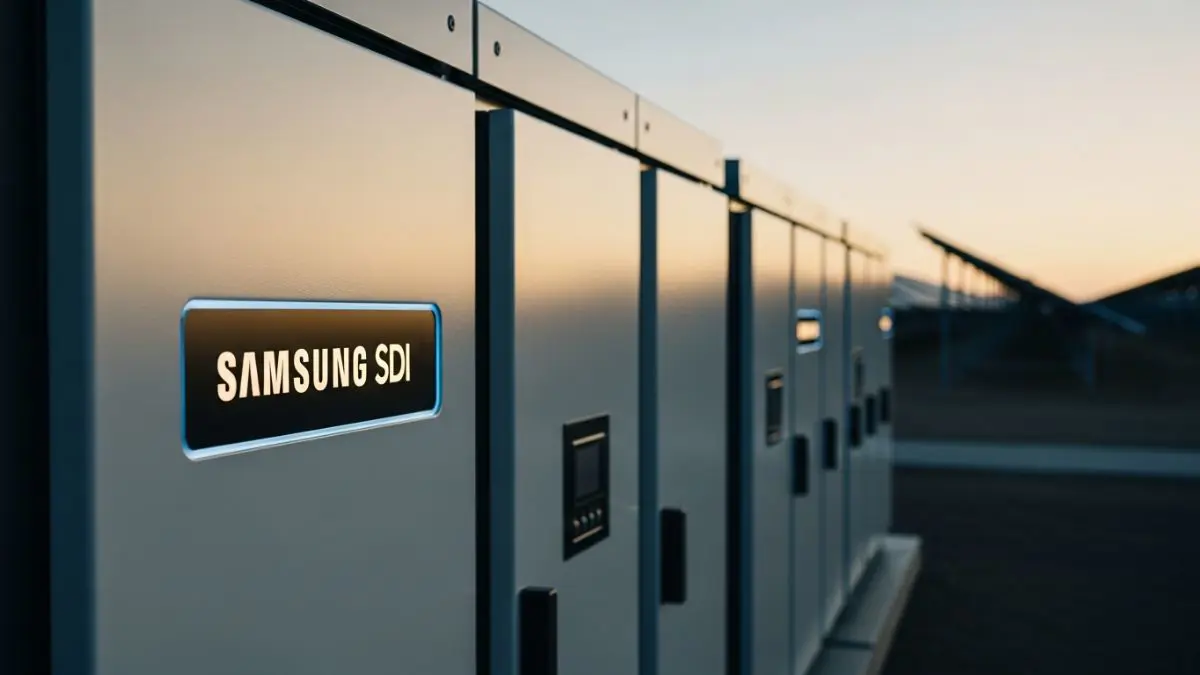
Samsung SDI Co. has secured a supply contract valued at over 2 trillion won ($1.36 billion) to provide energy storage batteries to a major U.S. client, signaling a decisive shift in strategy as the South Korean battery maker diversifies beyond the slowing electric vehicle (EV) sector.
The agreement, executed through subsidiary Samsung SDI America, involves the supply of lithium iron phosphate (LFP) batteries for Energy Storage Systems (ESS). The contract spans three years, with deliveries scheduled to commence in 2027.
While the company declined to name the customer due to confidentiality terms, it described the buyer as a leading player in U.S. energy infrastructure, highlighting the surging demand for grid-scale storage solutions needed to support artificial intelligence data centers and renewable energy farms.
Shares rally on news
Investors responded positively to the announcement. Samsung SDI shares surged as much as 6.1% in Seoul trading on Wednesday, significantly outperforming the benchmark KOSPI index. The rally reflects market relief that the company is successfully pivoting its manufacturing capacity toward the high-margin ESS sector to offset volatility in global EV demand.
Converting EV lines for storage
To fulfill the order, Samsung SDI plans to convert existing production lines at its U.S. manufacturing facilities to produce prismatic LFP batteries. These units are increasingly preferred for stationary storage due to their cost-efficiency, safety profile, and longer lifespan compared to nickel-based alternatives.
The batteries will be manufactured at the company’s joint venture facility with Stellantis NV in Indiana. The decision to repurpose capacity originally intended for EV cells highlights a broader industry trend: as U.S. EV adoption rates moderate, manufacturers are retrofitting lines to serve the booming demand for power grid stabilization.
Strategic pivot to stability
The deal underscores a critical realignment for South Korean battery majors. With the phase-out of certain U.S. subsidies for foreign-made EV components and fluctuating automotive demand, energy storage has emerged as a vital growth engine.
Unlike EV batteries, which prioritize weight and energy density, ESS batteries are engineered for longevity and stationary reliability. This makes them essential for utilities and hyperscale tech companies seeking to manage power loads from solar and wind sources.
Brief Summary
Samsung SDI has signed a $1.36 billion (2 trillion won) contract to supply LFP batteries for U.S. energy storage systems starting in 2027. The batteries will be produced by converting existing EV production lines at its Indiana plant. The move caused shares to jump over 6% and highlights the company’s strategic shift toward grid-scale storage amid a slowdown in the electric vehicle market.
Frequently Asked Questions (FAQs)
Q1: What are the key terms of the deal?
Samsung SDI will supply lithium iron phosphate (LFP) batteries worth approximately $1.36 billion to an unnamed U.S. energy infrastructure client. Deliveries are set to begin in 2027 and run for three years.
Q2: Why is Samsung SDI using EV production lines for this?
The company is converting lines at its Indiana joint venture plant (with Stellantis) to optimize capacity. With EV demand growth temporarily slowing, repurposing these lines for Energy Storage Systems (ESS) allows the company to maintain high utilization rates and capture revenue from a faster-growing sector.
Q3: Why did the stock price react so strongly?
Shares rose as much as 6.1% because investors view the deal as proof that Samsung SDI can successfully diversify its revenue. It reduces reliance on the volatile EV market and secures long-term cash flow from the stable energy infrastructure sector.
Q4: What is the difference between LFP and standard EV batteries?
LFP (Lithium Iron Phosphate) batteries are generally cheaper to produce, safer, and have a longer lifespan than the Nickel-Cobalt-Aluminum (NCA) batteries often used in high-performance EVs. These traits make LFP the chemistry of choice for stationary energy storage, where weight is not a primary concern.
Q5: What is driving the U.S. demand for battery storage?
Demand is being driven by the need to stabilize the power grid as more renewable energy (wind/solar) comes online, as well as the massive power requirements of new AI data centers, which require backup power solutions.

























