Solar cell supply concerns rise as India tightens domestic sourcing norms
By Cygnus | 21 Apr 2026
Summary
- Capacity imbalance: India’s solar module manufacturing capacity significantly exceeds domestic solar cell production, creating supply-side pressure.
- Technology gap: Limited availability of advanced cell technologies like TOPCon is emerging as a key constraint for manufacturers.
- Policy transition: The Ministry of New and Renewable Energy (MNRE) is moving toward stricter domestic sourcing under the Approved List of Models and Manufacturers (ALMM), though timelines remain under industry discussion.
NEW DELHI, April 21, 2026 — India’s solar manufacturing ecosystem is facing growing pressure as the transition toward stricter domestic sourcing norms highlights a structural gap between module assembly capacity and upstream solar cell production.
Industry stakeholders have raised concerns with the Ministry of New and Renewable Energy (MNRE) about the pace of implementation of ALMM List-II (cells), which is expected to require the use of domestically manufactured solar cells for certain categories of projects, particularly those linked to government procurement.
Capacity mismatch across the value chain
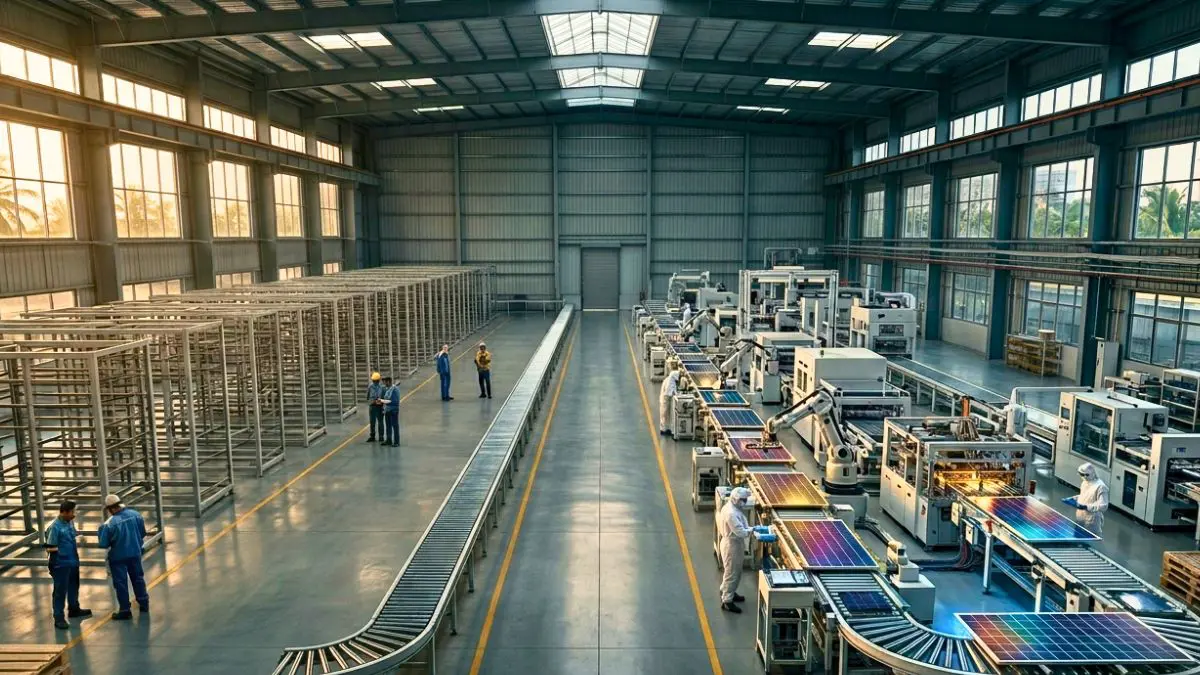
India has rapidly expanded its solar module manufacturing base over the past few years, with capacity estimates widely ranging above 100 GW. However, domestic solar cell manufacturing capacity remains significantly lower, creating a dependency gap.
This imbalance becomes more critical as India continues to add large-scale solar capacity annually under its renewable energy targets.
Technology transition adds complexity
The global solar market is shifting toward higher-efficiency technologies such as TOPCon (Tunnel Oxide Passivated Contact).
While Indian manufacturers are investing in upgrading facilities, a significant portion of existing capacity is still based on earlier technologies such as PERC, which may not fully align with evolving developer preferences.
Policy enforcement and traceability
The ALMM framework is designed to ensure quality control and promote domestic manufacturing by restricting eligible suppliers for government-backed projects.
Authorities are also exploring stricter traceability mechanisms to verify the origin of solar components, reducing reliance on imported cells being routed through domestic assembly.
Why this matters
- Supply chain alignment: A balanced ecosystem between cells and modules is critical for scaling solar deployment
- Cost implications: Limited domestic supply could lead to short-term price pressures in compliant segments
- Energy transition goals: Solar remains central to India’s non-fossil capacity expansion targets
- Manufacturing push: Policies like PLI aim to bridge upstream gaps over the medium term
FAQs:
Q1. What is ALMM List-II?
It refers to the proposed list covering domestically manufactured solar cells eligible for use in certain government-supported projects.
Q2. Will all solar projects require domestic cells?
No. Typically, only government-linked or subsidy-based projects fall under such requirements; private projects may have more flexibility.
Q3. Is India facing a solar supply crisis?
Not a crisis, but a transitional supply constraint as domestic manufacturing scales up to meet policy requirements.

























