India positions BRICS as stabilizing force amid internal divisions
By Axel Miller | 14 May 2026
Summary
- Global South positioning: India, as BRICS chair, is positioning the expanded grouping as a platform for Global South economic coordination and reform of multilateral institutions.
- Internal divergence: The enlarged BRICS framework continues to face coordination challenges due to differing geopolitical alignments among members, particularly on Middle East and Western relations.
- Consensus constraints: As a consensus-based bloc, BRICS often struggles to issue unified positions on security conflicts, limiting its effectiveness beyond economic cooperation.
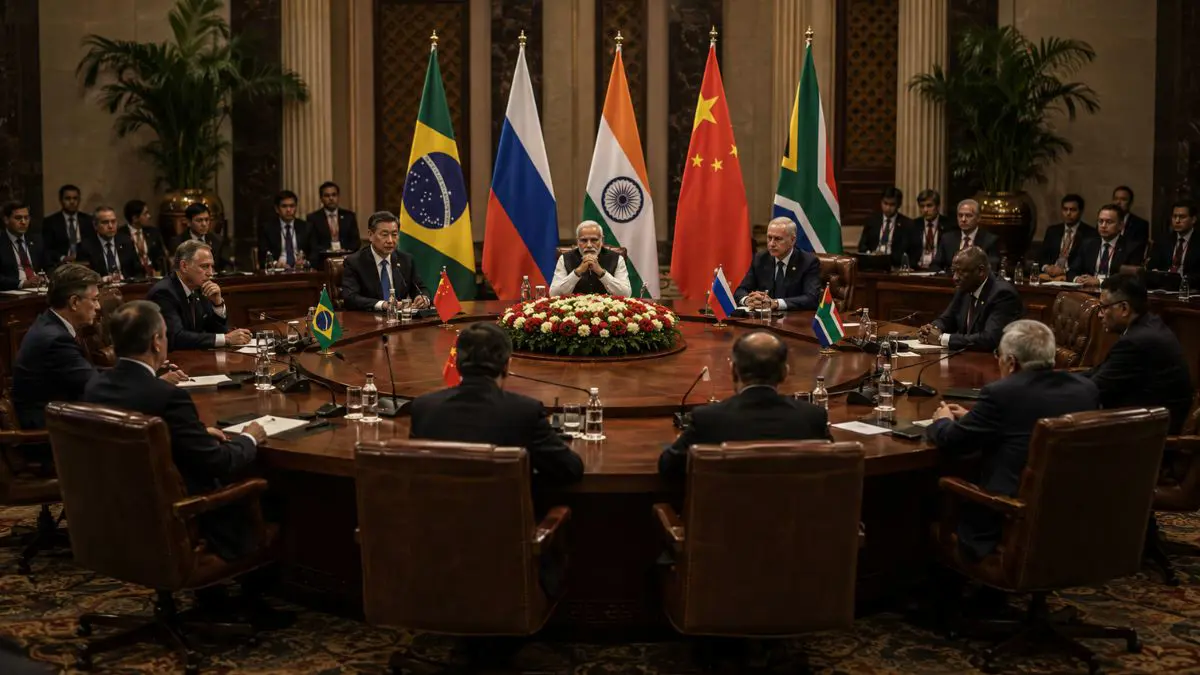
New Delhi, May 14, 2026 — India opened the BRICS Foreign Ministers’ meeting in New Delhi with renewed emphasis on strengthening the bloc’s role as a voice for the Global South. The discussions, however, reflect ongoing structural limitations in BRICS decision-making, particularly on geopolitical and security issues.
Indian External Affairs Minister S. Jaishankar underscored the importance of economic resilience, supply chain stability, and multilateral reform, reiterating India’s long-standing position that emerging economies need greater representation in global governance. While the remarks framed BRICS as a stabilizing platform, the summit remains largely focused on economic coordination rather than binding security commitments.
Structural limits of BRICS consensus
The expanded BRICS grouping—now including Brazil, Russia, India, China, South Africa, Egypt, Ethiopia, Indonesia, Iran, and the United Arab Emirates—operates strictly on consensus. This structural requirement has repeatedly limited the bloc’s ability to issue strong joint statements on contentious geopolitical issues.
As of recent summits, member states have diverging positions on key international conflicts, making unified language on security matters difficult. Diplomatic analysts note that this is not new; BRICS has historically functioned more effectively as an economic coordination platform than as a geopolitical alliance.
Middle East tensions and diplomatic sensitivity
The narrative of an internal Iran–UAE confrontation involving military deployments or direct conflict within BRICS is not supported by verified public diplomatic records or credible reporting as of 2025.
However, it is accurate that BRICS expansion has brought together states with competing regional alignments, particularly in the Middle East. This increases diplomatic complexity when discussing energy security, sanctions, and global conflict positioning.
Iran and the UAE maintain different strategic relationships with Western powers and regional actors, which can lead to policy divergence inside multilateral forums, even if not an active internal bloc conflict.
Economic agenda remains central
Despite geopolitical tensions, BRICS discussions continue to prioritize:
- Trade settlement in local currencies
- Supply chain resilience
- Development financing via New Development Bank (NDB)
- Infrastructure investment coordination
- Gradual reduction of dependency on dollar-denominated trade
Analysts say these economic pillars remain the most actionable part of BRICS cooperation, while security alignment remains limited.
Why this matters
- BRICS expansion increases influence but also adds members with differing geopolitical priorities, making consensus harder to achieve.
- India’s chairmanship reflects a balancing act between Western partnerships (such as the Quad) and leadership of Global South platforms.
- The bloc is likely to remain economically active but politically constrained, especially on conflict-related issues.
- Security disagreements among member states reinforce BRICS’ identity as a coordination forum rather than a unified geopolitical alliance.
FAQs
Q1. Who are the current BRICS members?
As of the expanded framework, BRICS includes Brazil, Russia, India, China, South Africa, Egypt, Ethiopia, Indonesia, Iran, and the UAE.
Q2. Does BRICS function as a political alliance?
No. BRICS is primarily an economic and development coordination platform, not a military or security alliance.
Q3. Why is consensus difficult in BRICS?
Because all decisions require unanimity, differing geopolitical interests often prevent unified positions on conflicts.
Q4. What is India’s goal as BRICS chair?
India aims to strengthen economic cooperation, reform global institutions, and enhance Global South representation in multilateral governance.