Mumbai's trans harbour link approval expected
By The eight-lane, two ra | 27 Feb 2004
Mumbai : The first phase of India's longest sea link project, a Rs 6,600-crore, 22.5-km bridge over the sea, known as the Nhava-Sewri Trans-Harbour Sea Link, and named after the late JRD Tata, is expected to receive the central government's approval. The Maharashtra State Road Development Corporation (MSRDC) has already issued the pre-bid documents in anticipation of the approval. The project has been approved by the state government, and the Union surface transport ministry.
The Mumbai Trans Harbour Link (MTHL) bridge will be an eight-lane (two-way, four-lane) highway connecting Sewri in South Mumbai to Nhava in Navi Mumbai over the sea. Its minimum vertical clearance will be 9.1 m and the maximum vertical clearance 25 m at select locations. The estimated cost of the first phase of this turnkey project is Rs1,800 crore. The entire project is expected to take four years. Selection of the bidder or consortium of bidders will be made through an international competition on a lump sum / turnkey basis to be financed by MSRDC.
The Mumbai Trans-Harbour Link will promote the future development of the city in an east-west direction, thereby considerably reducing pressure on the city's road and rail network. It will provide a road and rail link from Sewri in south Mumbai to Nhava near the Jawaharlal Nehru Port Trust (JNPT), in Navi Mumbai. This link will come up on the northern end of the navigational channel of the Mumbai Harbour.
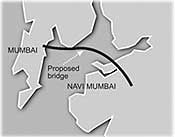 The project involves the construction of a 22.5 km long main bridge across the harbour with traffic dispersal systems at both ends. The dispersal system in Mumbai will be in the form of interchanges and elevated roads connecting the major arteries of the city. Similarly the dispersal system on the main land involves interchanges and connectors to the Navi Mumbai road network, Mumbai - Pune highway, Mumbai-Pune expressway, Mumbai - Goa highway and finally, Mumbai - Chennai highway, which is a part of the golden quadrilateral project.
The other project benefits would be the connection between the two major ports — Mumbai's Bombay Port Trust (MbPT)and JNPT in Navi Mumbai, and an extension of the central and western railway connections to the main land. Also, the provision of multi-storied car parks with interchanges and shuttle bus services to south Mumbai will reduce traffic on city roads. While the road bridge will have eight lanes the rail bridge will have two rail tracks. A state of the art traffic surveillance, monitoring and enhanced safety system along with a modern toll plaza with a automatic toll collection system would be the other features of the proposed link. Environmentalists, however, are up in arms against the project.
Latest articles









Featured articles

The decoupling paradox: Why Wall Street keeps funding AI despite $100 oil
By Axel Miller | 11 May 2026
AI infrastructure stocks continue rallying despite $100 oil as investors bet on productivity gains and semiconductor demand in 2026.

Hybrid bonding gains attention as AI chip packaging demand grows
By Cygnus | 23 Apr 2026
Hybrid bonding is driving AI chip packaging demand as backend technologies gain importance in the semiconductor supply chain.

The agentic transition: how enterprises are scaling AI from pilot to profit
By Cygnus | 22 Apr 2026
AI has entered its execution era. Discover how companies like Valeo and Microsoft are scaling agentic AI systems—from copilots to autonomous workflows driving real business impact.

Post-splashdown: What Artemis II taught us about the ‘deep space wall’
By Axel Miller | 15 Apr 2026
Artemis II splashdown marks a breakthrough in deep space exploration. Discover AVATAR radiation data, Orion’s distance record, and insights shaping NASA’s 2028 Moon mission.

Can aviation go green? The multi-billion dollar race for sustainable fuel
By Cygnus | 10 Apr 2026
Airlines are racing to adopt sustainable aviation fuel, but limited supply and high costs challenge the future of green aviation.

The battery race: who will control the future of electric vehicles?
By Axel Miller | 08 Apr 2026
The global battery race is reshaping the electric vehicle industry, with China, the US, and Europe competing for control over supply chains and technology.

AI vs governments: Who controls the future of intelligence?
By Cygnus | 07 Apr 2026
Governments and AI companies like OpenAI and Anthropic are shaping the future of intelligence amid rising policy conflicts and global competition.

Strait of Hormuz: how one chokepoint controls the global economy
By Axel Miller | 06 Apr 2026
The Strait of Hormuz is a critical global chokepoint. Learn how disruptions impact oil prices, shipping, and the global economy.

The $2 trillion AI infrastructure race: Who will control global compute?
By Cygnus | 06 Apr 2026
AI spending is set to exceed $2 trillion in 2026, driving a global race in data centers, chips, and energy infrastructure.


Latest articles





