Press the right brakes, save your life
26 Mar 2007
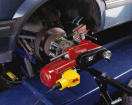 In some cases the car driver can feel a pulsation or vibration in the brake pedal every time a car stops, though the brakes seem to work fine.
Car experts say a pulsating brake pedal, which is accompanied by a shuddering or jerky stop during normal braking, usually means a warped rotor or an out-of-round drum — although it can sometimes be caused by loose wheel bearings, a bent axle shaft or loose brake parts. Some pedal feedback and noise is normal during panic stops or when braking on wet or slick surfaces. But there should not be pedal feedback when braking normally on dry roads.
The faces of a disc brake rotor must be parallel (within .0005 inch on most cars) and flat (no more than about .002 to .005 inches of run-out) otherwise it will kick the brake pads in and out when the brakes are applied, producing a pulsation or vibration that can be felt in the brake pedal as the rotor alternately grabs and slips.
One can often see visible warps in a brake rotor. If the rotor has telltale glazed or discoloured patches on its face, it is probably warped. Measuring it with a dial indicator and checking it for flatness with a straight edge will confirm the diagnosis.
 Resurfacing the rotor to restore the faces and remove the pulsation. But it will be temporary because of metallurgical changes that take place in the rotor. Resurfacing will restore the surface, but the warps may reappear again in a few thousand miles as the rotor wears. For this reason, some companies recommend replacing warped rotors rather than resurfacing them.
Rotors get warped due to several reasons most common being overtorquing or unevenly torquing the lug nuts with an impact wrench. For this reason, experts recommend using a torque wrench to tighten lug nuts when changing a wheel. There are also special torque-limiting extension sockets called ‘torque sticks’ that can be safely used with an impact wrench to accurately tighten lug nuts. But a plain impact wrench should never be used for the final tightening of the lug nuts because most provide no control whatsoever over the amount of torque applied to the nuts.
Another reason why rotors get warped is overheating which is the result of severe abuse or dragging brakes.
Latest articles









Featured articles

Server CPU Shortages Grip China as AI Boom Strains Intel and AMD Supply Chains
By Cygnus | 06 Feb 2026
Intel and AMD server CPU shortages are hitting China as AI data center demand surges, pushing lead times to six months and driving prices higher.

Budget 2026-27 Seeks Fiscal Balance Amid Rupee Volatility and Industrial Stagnation
By Cygnus | 02 Feb 2026
India's Budget 2026-27 targets fiscal discipline with record capex as markets tumble, the rupee weakens and manufacturing struggles to regain momentum.

The Thirsty Cloud: Why 2026 Is the Year AI Bottlenecks Shift From Chips to Water
By Axel Miller | 28 Jan 2026
As AI server density surges in 2026, data centers face a new bottleneck deeper than chips — the massive water demand required for cooling next-generation infrastructure.

The New Airspace Economy: How Geopolitics Is Rewriting Aviation Costs in 2026
By Axel Miller | 22 Jan 2026
Airspace bans, sanctions and corridor risk are forcing airlines into costly detours in 2026, raising fuel burn, reducing aircraft utilisation and pushing airfares higher worldwide.

India’s Data Center Arms Race: The Battle for Power, Cooling, and AI Real Estate
By Cygnus | 22 Jan 2026
India’s data centre boom is turning into an AI arms race where power contracts, liquid cooling and fast commissioning decide the winners across Mumbai, Chennai and Hyderabad.

India’s Oil Balancing Act: Refiners Rebuild Middle East Supply Lines as Russia Flows Disrupt
By Axel Miller | 21 Jan 2026
India’s refiners are rebalancing crude sourcing as Russian imports fell to a two-year low in December 2025, lifting OPEC’s share and raising geopolitical risk concerns.

Arctic Fever: How ‘Greenland Tariff’ Politics Sparked a Global Flight to Safety
By Axel Miller | 20 Jan 2026
Greenland-linked tariff threats have injected fresh uncertainty into transatlantic trade, triggering a risk-off shift in markets and reshaping global supply chain planning.

The New Oil (Part 5): Friend-Shoring, Supply Chain Fragmentation and the Cost of Resilience
By Cygnus | 19 Jan 2026
Friend-shoring is reshaping lithium, rare earth and graphite supply chains, creating a resilience premium and new winners and losers in clean tech.

The New Oil (Part 4): Can Technology Break the Dependency?
By Cygnus | 16 Jan 2026
Can magnet recycling and rare-earth-free motors reduce global dependence on strategic minerals? Part 4 explores breakthroughs, limits and timelines.

Latest articles





