Scripps/NASA demonstrate novel ocean-powered underwater vehicle
22 Apr 2010
US Navy and Scripps Institution of Oceanography at University College of San Diego researchers have successfully demonstrated the first robotic underwater vehicle to be powered entirely by natural, renewable, ocean thermal energy.
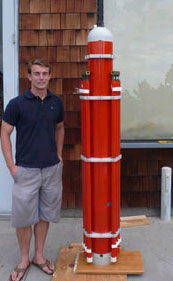 |
| Kyle Grindley, an engineer in the Instrument Development Group at Scripps Oceanography, helped design the SOLO-TREC autonomous underwater vehicle seen here. |
Researchers at NASA's Jet Propulsion Laboratory, Pasadena, Calif.; and Scripps completed the first three months of an ocean endurance test of the prototype vehicle off the coast of Hawaii in March.
"People have long dreamed of a machine that produces more energy than it consumes and runs indefinitely," said Jack Jones, a JPL principal engineer and SOLO-TREC co-principal investigator. "While not a true perpetual motion machine, since we actually consume some environmental energy, the prototype system demonstrated by JPL and its partners can continuously monitor the ocean without a limit on its lifetime imposed by energy supply."
"Most of Earth is covered by ocean, yet we know less about the ocean than we do about the surface of some planets," said Yi Chao, a JPL principal scientist and SOLO-TREC principal investigator. "This technology to harvest energy from the ocean will have huge implications for how we can measure and monitor the ocean and its influence on climate."
SOLO-TREC draws upon the ocean's thermal energy as it alternately encounters warm surface water and colder conditions at depth. Key to its operation are the carefully selected waxy substances known as phase-change materials that are contained in 10 external tubes, which house enough material to allow net power generation.