Fleeting fluctuations in superconductivity disappear close to transition temperature
14 Feb 2011
As part of an ongoing effort to uncover details of how high-temperature superconductors carry electrical current with no resistance, scientists at Johns Hopkins University and the US Department of Energy's Brookhaven National Laboratory have measured fluctuations in superconductivity across a wide range of temperatures using terahertz spectroscopy.
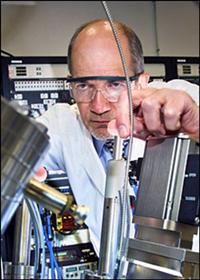 Their technique allows them to see fluctuations lasting mere billionths of a billionth of a second, and reveals that these fleeting fluctuations disappear 10-15 Kelvin (K) above the transition temperature (Tc) at which superconductivity sets in.
''Our findings suggest that in cuprate superconductors, the transition to the non-superconducting state is driven by a loss of coherence among the electron pairs,'' said Brookhaven physicist Ivan Bozovic, a co-author on a paper describing the results in Nature Physics online, February 13, 2011.
Scientists have been searching for an explanation of high-Tc superconductivity in cuprates since these materials were discovered some 25 years ago. Because they can operate at temperatures much warmer than conventional superconductors, which must be cooled to near absolute zero (0 K or -273 degrees Celsius), high- Tc superconductors have the potential for real world applications. If scientists can unravel the current-carrying mechanism, they may even be able to discover or design versions that operate at room temperature for applications such as zero-loss power transmission lines. For this reason, many researchers believe that understanding how this transition to superconductivity occurs in cuprates is one of the most important open questions in physics today.
In conventional superconductors, electron pairs form at the transition temperature and condense into a collective, coherent state to carry current with no resistance. In high- Tc varieties, which can operate at temperatures as high as 165 K, there are some indications that electron pairs might form at temperatures 100-200 K higher, but only condense to become coherent when cooled to the transition temperature.
''These fluctuations are something like small islands or droplets of superconductivity, within which the electron pairs are coherent, which pop up here and there and live for a while and then evaporate to pop up again elsewhere,'' Bozovic said. ''Such fluctuations occur in every superconductor,'' he explained, ''but in conventional ones only very, very close to Tc - the transition is in fact very sharp.''

























