Researchers work on software for efficient computing for nanoscale devices
By By Doug Ramsey | 02 Sep 2010
As semiconductor manufacturers build ever smaller components, circuits and chips at the nano scale become less reliable and more expensive to produce. The variability in their behavior from device to device and over their lifetimes – due to manufacturing, aging-related wear-out, and varying operating environments – is largely ignored by today's mainstream computer systems.
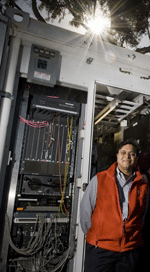 Now a visionary team of computer scientists and electrical engineers from six universities is proposing to deal with the downside of nanoscale computer components by re-thinking and enhancing the role that software can play in a new class of computing machines that are adaptive and highly energy efficient.
The National Science Foundation (NSF) today awarded a $10 million, five-year grant to researchers who will explore ''Variability-Aware Software for Efficient Computing with Nanoscale Devices.'' The grant is part of the funding agency's Expeditions in Computing program, which rewards far-reaching agendas that ''promise significant advances in the computing frontier and great benefit to society.''
''We envision a world where system components – led by proactive software – routinely monitor, predict and adapt to the variability in manufactured computing systems,'' said Rajesh Gupta, director of the Variability Expedition and a professor of computer science and engineering at the University of California, San Diego's Jacobs School of Engineering. ''Changing the way software interacts with hardware offers the best hope for perpetuating the fundamental gains in computing performance at lower cost of the past 40 years.''
Joining Gupta in this effort is the expedition's deputy director and electrical engineering professor Mani Srivastava from the University of California, Los Angeles' Henry Samueli School of Engineering and Applied Science, and a team of eleven other computer scientists and electrical engineers from University of Michigan, Stanford University, University of California, Irvine (UCI) and the University of Illinois at Urbana-Champaign (UIUC). The project is based in the UCSD division of the California Institute for Telecommunications and Information Technology (Calit2).
Researchers on the team include: Ranjit Jhala, Sorin Lerner, Tajana Simunic Rosing, Steve Swanson and Yuanyuan (YY) Zhou from UC San Diego; Lara Dolecek and Puneet Gupta from UCLA Engineering; Subhasish Mitra from Stanford; Dennis Sylvester from Michigan; Rakesh Kumar from UIUC's Coordinated Science Laboratory; as well as Nikil Dutt and Alex Nicolau from UCI's Center for Embedded Computer Systems.