Research a key step toward quantum computers
20 Apr 2012
Harvard scientists have taken a critical step toward building a quantum computer - a device that could someday harness, for example, the intrinsic properties of subatomic particles such as electrons to perform calculations far faster than the most powerful supercomputers.
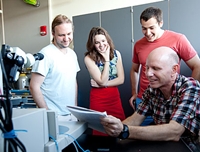 As described in a paper published April 13 in Science, researchers have, for the first time, demonstrated a system in which two semiconducting spin quantum bits, or qubits, interact with each other in a process known as entanglement. Without that entanglement, quantum computers simply can't exist.
''Entanglement is an essential component of quantum computing - it's what gives you the ability to do generalised, universal quantum computation,'' said Amir Yacoby, professor of physics and of applied physics, who led the research. ''Without this kind of entanglement, there's no way to get anywhere in this field.''
Quantum computers rely on quantum mechanical properties of particles to store data and perform computations. Unlike the transistors used in digital computers, which encode data ''bits'' as either zero or one, qubits can hold both values simultaneously. In theory, that inherently parallel nature allows quantum computers to be vastly more powerful than traditional computers, which perform operations in sequence.
As a first step toward making those parallel computations possible, researchers working in Yacoby's lab have established a new method for creating an entangled state between two qubits. By taking advantage of the electrostatic interaction between the particles, Yacoby, in collaboration with postdoctoral researchers Oliver Dial and Hendrik Bluhm, and graduate students Michael Shulman and Shannon Harvey, was able to create pairs of qubits in a state that has no classical analog, known as an entangled state.
By entangling one qubit with another, researchers can control the state of one qubit by operating on the other. This interconnectedness gives quantum computers their advantage over their classical counterparts.

























