Future computer vision tools to aid medical research, healthcare
By By Andrea Siedsma | 07 Apr 2011
Boris Babenko believes there are huge opportunities for integrating computer science, and in particular computer vision, into health care and medical research, making life easier for researchers, physicians and ultimately patients.
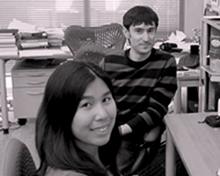 |
| UC San Diego bioengineering grad student Jessica DeQuach (front) and computer science grad student Boris Babenko are developing powerful tools to aid in bioengineering research. They will present their work during Research Expo April 14. |
Babenko, a UC San Diego computer science grad student, is working with a team of researchers to develop technology that will automate the arduous process of analyzing the vast amount of data necessary for tissue engineering.
Babenko's strong conviction is leading to the development of powerful tools to aid in bioengineering research. In their research, Babenko and his partner, bioengineering grad student Jessica DeQuach, seek to automate blood vessel counting in images, and to make the distinction between data collection and analysis more clear.
Tissue engineering is an interdisciplinary field that offers the promise of improving, repairing and/or replacing damaged tissue in the human body.
Research in this area involves the development of various biomaterials and processes that facilitate the fabrication of such tissue. In their project, the engineering students are focusing on quantifying arteriole formation. An arteriole is one of the small terminal branches of an artery, especially one that connects with a capillary.
''Arteriole formation is critically important for biomaterial remodeling to help bring blood flow to the damaged area, which is why it is an analysis tool often using in tissue engineering,'' DeQuach said.
Collecting this vast amount of data is currently done manually and requires an intensive amount of time and meticulous effort.
''In this project we aim to ease the burden of doing such analysis via modern computer vision techniques,'' Babenko said. ''While the state of the art in computer vision still requires expert oversight, the long-term goal of our work is to automate this process as much as possible.''
The students are working under computer science professor Serge Belongie and bioengineering professor Karen Christman.
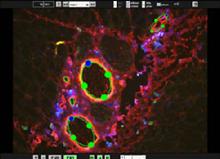 |
| UC San Diego engineers are developing tools to automate blood vessel counting in images, and to make the distinction between data collection and analysis more clear. |
Babenko explained that analysing images is a central issue in biology – either to study things that are too small for the naked eye, or to study something from the inside in a non-invasive manner. With current imaging and computer technologies researchers can gather huge amounts of data. Much of this analysis, however, is still done manually.
"I think that computer vision technology could make a big impact in this area by offering powerful tools to aid in bioengineering research,'' Babenko said. ''Counting blood vessels is a perfect example of the tedious task bioengineers have to perform.
For example, in Prof Christman's lab a typical experiment requires a scientist to spend up to 80 hours to annotate images, and yet we believe it is within the reach of current computer vision technology.''The short term goal is to significantly reduce the amount of time this analysis takes, while the long term goal is to open up new possibilities for experiments that simply could not have been done due to this annotation bottleneck,'' he added. ''Computer vision is a fast growing field, and this progress is ready to be applied in the real world.''

























