Another step toward quantum computers: using photons for memory
By By Eric Gershon | 02 Apr 2013
Scientists at Yale University have found a new way to manipulate microwave signals that could aid the long-term effort to develop a quantum computer, a powerful tool that would revolutionize information processing through unprecedented speed and power.
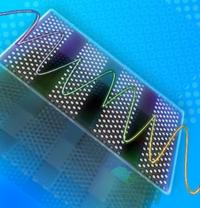 Like regular (classical) computers, quantum computers must be able to receive, store, and manipulate information in order to perform calculations. But the fragile nature of quantum information - which exists as a ''0'' or ''1'' or both simultaneously - poses challenges. In research published on 14 March in the journal Nature, Yale physicists report an advance in developing memory mechanisms.
The advance involves photons, the smallest units of microwave signals, which can serve as a quantum computer's memory, like the RAM of a regular computer.
Photons can carry and hold quantum information for a long time, because they interact weakly with the media they typically travel through - coaxial cables, wires, or air, for example. The weakness of these interactions prevents the photons from being absorbed by the medium and preserves the quantum information, once it's been encoded.
In the Nature paper, the researchers report creating an artificial medium in which photons repel photons, allowing for efficient, non-destructive encoding and manipulation of quantum information.
''Our experiment has shown that we can create a medium that on the one hand enables us to manipulate the photon state, and on the other hand does not absorb the photons, which would destroy the quantum information stored in them,'' said Gerhard Kirchmair, a postdoctoral researcher at Yale and the paper's lead author. ''This creates a source for novel quantum states without the need for complicated control techniques and could simplify certain quantum computation algorithms. In the long run it could be used as one of the many resources required to build a quantum computer.''
The medium consists of a superconducting qubit coupled to a microwave cavity resonator.
Robert J. Schoelkopf, a professor of applied physics and physics at Yale, led the research team.
The paper, titled ''Observation of quantum state collapse and revival due to the single-photon Kerr effect,'' contains a complete list of co-authors.
''The tricky bit for future experiments will be to switch on and off this effect at will, so that it only happens if we want it to happen,'' said Kirchmair. ''We already have experiments on the way that show that we can do that.''
The National Science Foundation, the US Army, the French Angence Nationale de la Recherche, the Swiss NSF, and the British Engineering and Physical Sciences Research Council all supported the research.

























