Qualcomm and Arm face a legal battle that could reshape chip licensing
By Axel Miller | 12 Oct 2026
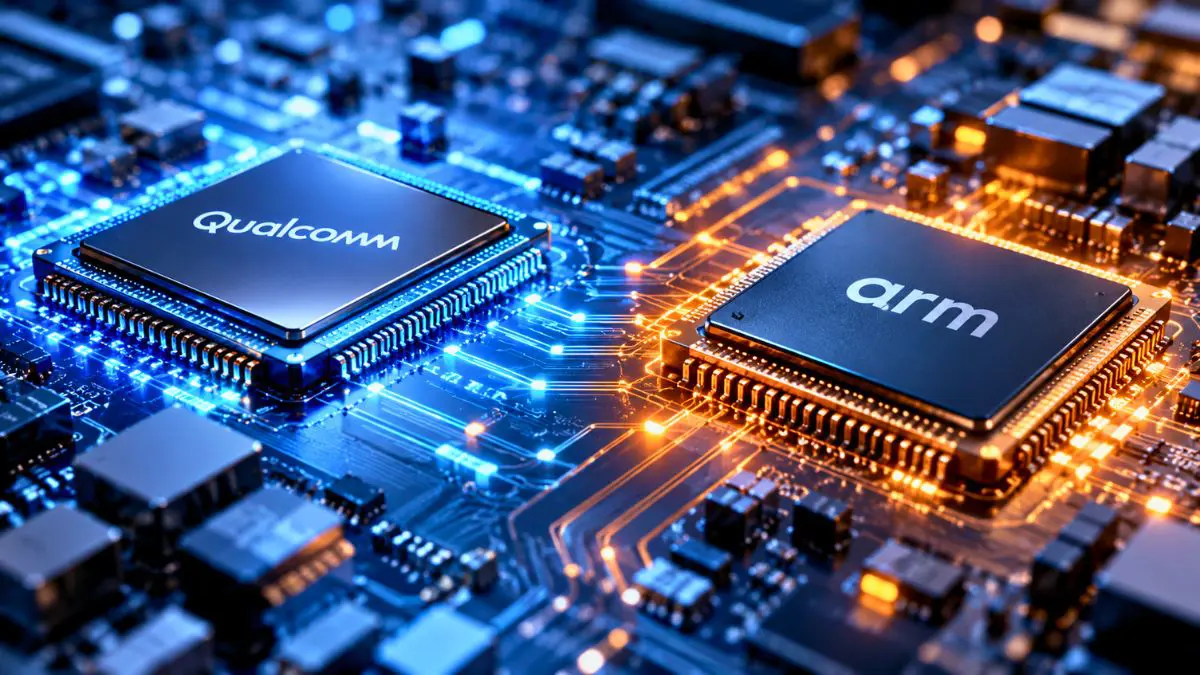
Summary
- Delaware jury deliberations: A federal jury in Wilmington, Delaware, is expected to resume deliberations on October 13, 2026, in Qualcomm’s breach-of-contract lawsuit against Arm Holdings. Qualcomm alleges that Arm withheld software tools, breached pricing commitments and interfered with a potential commercial deal with Meta Platforms.
- The supplier-competitor dilemma: Arm’s March 2026 launch of the Arm AGI CPU marked its entry into production silicon, expanding its business beyond intellectual property licensing and creating new strategic questions for its existing licensees.
- Architectural alternatives: The dispute highlights the importance of predictable chip licensing agreements and may strengthen industry interest in alternative instruction set architectures, including RISC-V. However, the extent to which the litigation will accelerate adoption remains uncertain.
WILMINGTON, Del., October 12, 2026 — A closely watched legal dispute between Qualcomm Inc. and Arm Holdings is putting semiconductor licensing agreements under scrutiny as the two companies contest their contractual obligations, technical support arrangements and commercial interests.
A federal jury in the U.S. District Court for the District of Delaware had not reached a verdict by October 9, with deliberations expected to resume on October 13. The lawsuit, brought by Qualcomm, alleges that Arm breached licensing agreements by withholding required software tools, failing to meet contractual pricing obligations and improperly publicising a notice concerning the possible termination of Qualcomm’s architecture licence. Qualcomm contends that the disclosure damaged negotiations over a potential chip-related business opportunity with Meta Platforms. Arm disputes Qualcomm’s allegations and argues that the company has not demonstrated compensable commercial harm.
The litigation comes at a significant moment for the semiconductor industry. For decades, Arm’s business model centred on licensing processor technology to chipmakers that developed their own products. Its March 2026 introduction of the Arm AGI CPU, its first Arm-designed production silicon product, represents a strategic expansion into selling processors for AI data centres. Meta is the lead partner for the product, according to Arm’s announcement.
The combination of a licensing dispute and Arm’s expansion into production silicon has raised broader questions about the relationship between technology suppliers and their customers. The court proceedings may help clarify the parties’ contractual rights, although the ultimate impact on the wider semiconductor market will depend on the findings and any subsequent legal developments.
The changing role of Arm in the semiconductor ecosystem
For much of its history, Arm operated primarily as a semiconductor intellectual property (IP) company. Rather than manufacturing processors for sale, it licensed technology to chipmakers that integrated Arm-based designs into smartphones, computers, servers, automotive systems and other devices.
Its licensing model encompasses different levels of technology access:
Technology licensing agreements (TLAs): These agreements can provide access to processor designs and related technologies that customers integrate into their products, subject to the terms of the relevant licence.
Architecture licensing agreements (ALAs): These agreements provide rights to use an instruction set architecture, subject to contractual restrictions, allowing licensees to develop their own processor implementations.
Qualcomm has used Arm technology to develop custom CPU cores for its Snapdragon platforms. Other semiconductor companies also rely on Arm's ecosystem to build products across mobile computing and data-centre markets.
Arm’s March 24, 2026, announcement of the Arm AGI CPU marked a significant change in its commercial strategy. The company said it was extending its platform from IP and compute subsystems into production silicon, beginning with a processor designed for AI data-centre workloads.
This expansion does not mean Arm has abandoned licensing. Instead, it is adding a new product category to its existing business. Nevertheless, the move creates potential competitive overlap in markets where customers may choose between licensing Arm technology to develop their own chips and deploying Arm-designed processors.
The current lawsuit does not establish that Arm’s new silicon strategy caused the contractual disagreements. It does, however, bring attention to how licensing agreements function when long-standing commercial partners have overlapping interests.
From the Nuvia acquisition to the current lawsuit
The dispute between Qualcomm and Arm has roots in Qualcomm’s 2021 acquisition of semiconductor startup Nuvia for approximately $1.4 billion. Qualcomm acquired Nuvia to strengthen its ability to develop custom CPU technology, subsequently used in its Oryon processor designs.
Arm argued that Nuvia’s existing architecture licence could not be transferred or used under Qualcomm’s arrangements without the necessary permissions. The disagreement led to litigation over whether Qualcomm’s licence covered processors incorporating technology developed by Nuvia.
A jury considered the dispute in December 2024 but did not reach a complete verdict on all issues. It nevertheless found that Qualcomm had not breached its own architecture licence and that certain technology incorporating Nuvia’s work was properly licensed under Qualcomm’s agreement.
On September 30, 2025, the district court entered final judgment in Qualcomm and Nuvia’s favour on the remaining claims in Arm’s lawsuit. Arm filed an appeal on October 1, 2025, according to Qualcomm’s regulatory disclosures. The appeal is a separate proceeding from Qualcomm’s later breach-of-contract lawsuit against Arm.
The newer lawsuit, filed by Qualcomm in April 2024 and subsequently amended, concerns Qualcomm’s allegations that Arm failed to meet obligations under their licensing agreements. Qualcomm also alleges that Arm improperly sought to terminate its architecture licence and publicised the termination notice. Its claims include alleged failures to provide contractual deliverables and offers on commercially reasonable terms.
Arm rejects the allegations. The current jury trial therefore concerns a distinct set of claims from the earlier dispute over Nuvia’s licence, and its outcome should not be treated as predetermined by the 2025 judgment.
Licensing risks and the RISC-V alternative
The Qualcomm-Arm dispute highlights a wider issue for chipmakers: reliance on third-party technology can create contractual and commercial risks when access to software tools, design resources or licensing rights becomes contested.
The dispute may encourage companies to examine alternative architectures and strengthen contractual safeguards. However, there is not enough evidence to conclude that the lawsuit alone has accelerated industry-wide migration away from Arm.
One alternative is RISC-V, an open-standard instruction set architecture that companies can implement without paying royalties to a single proprietary ISA owner. Individual implementations, development tools and related services may still carry costs.
Industry initiatives such as Quintauris are working to support interoperable RISC-V solutions. The company was established by semiconductor and technology firms including Qualcomm, Bosch, Infineon, Nordic Semiconductor and NXP Semiconductors. Its work focuses on making RISC-V implementations more consistent and suitable for commercial applications, particularly in automotive and embedded systems.
RISC-V is not an immediate replacement for Arm across every market. Switching architectures can require substantial engineering investment, software porting, validation and ecosystem development. For many chipmakers, the choice will depend on performance, power efficiency, software availability, development costs and the commercial terms of existing agreements.
The legal dispute also illustrates why semiconductor companies may seek clearer contractual provisions covering software tool access, technical support, pricing changes, termination rights and dispute resolution. Such provisions can reduce uncertainty when products require years of development and long qualification cycles.
For India’s growing semiconductor design ecosystem, the case offers a relevant lesson. Startups and established chip designers need reliable access to IP, development tools and technical support. Transparent licensing arrangements can help companies manage development costs and reduce uncertainty when bringing new processors to market.
Why this matters
- IP contract certainty: The verdict could clarify important contractual questions about the delivery of software tools, licensing prices and interference with customer relationships. Its implications will depend on the jury’s findings and any subsequent court decisions.
- Custom processor development: Qualcomm’s Oryon technology is important to its strategy of developing custom CPUs for Snapdragon products. The dispute underscores the commercial significance of maintaining access to licensed technology while building differentiated processors.
- Competition in AI silicon: Arm’s entry into production silicon adds a new dimension to its relationship with customers that develop their own processors. The implications will depend on product positioning, customer choices and the continued operation of its licensing business.
- Alternative architectures: RISC-V provides a potential route to reduce dependence on proprietary instruction set licensing. Wider adoption, however, will depend on software maturity, implementation quality and total development costs.
- Semiconductor investment: Predictable licensing terms and dependable technical support are important for companies investing in chip design, including emerging fabless businesses in India.
FAQs
Q1: What is the main disagreement between Qualcomm and Arm?
Qualcomm alleges that Arm breached their licensing agreements by withholding required software tools, failing to meet contractual pricing obligations and improperly disclosing a notice concerning the possible termination of Qualcomm’s architecture licence. Qualcomm also alleges that the disclosure harmed a potential commercial opportunity involving Meta. Arm disputes the claims.
Q2: How did Qualcomm’s acquisition of Nuvia contribute to the dispute?
Qualcomm acquired Nuvia in 2021 for approximately $1.4 billion to strengthen its custom CPU development capabilities. Arm subsequently challenged the licensing arrangements covering Nuvia’s technology. In September 2025, a federal court entered final judgment in Qualcomm and Nuvia’s favour on the remaining claims in that earlier case. Arm appealed, while Qualcomm’s separate contractual lawsuit against Arm continued.
Q3: What is RISC-V, and why is it relevant?
RISC-V is an open-standard instruction set architecture that companies can implement without paying royalties to a proprietary ISA owner. It offers an alternative to architectures such as Arm, although building a competitive processor still requires investment in hardware design, software, verification and ecosystem development. Initiatives such as Quintauris are working to support commercial RISC-V implementations.