Musk ramps up SpaceX moon plans as Bezos accelerates Blue Origin in race against China
By Axel Miller | 13 Feb 2026
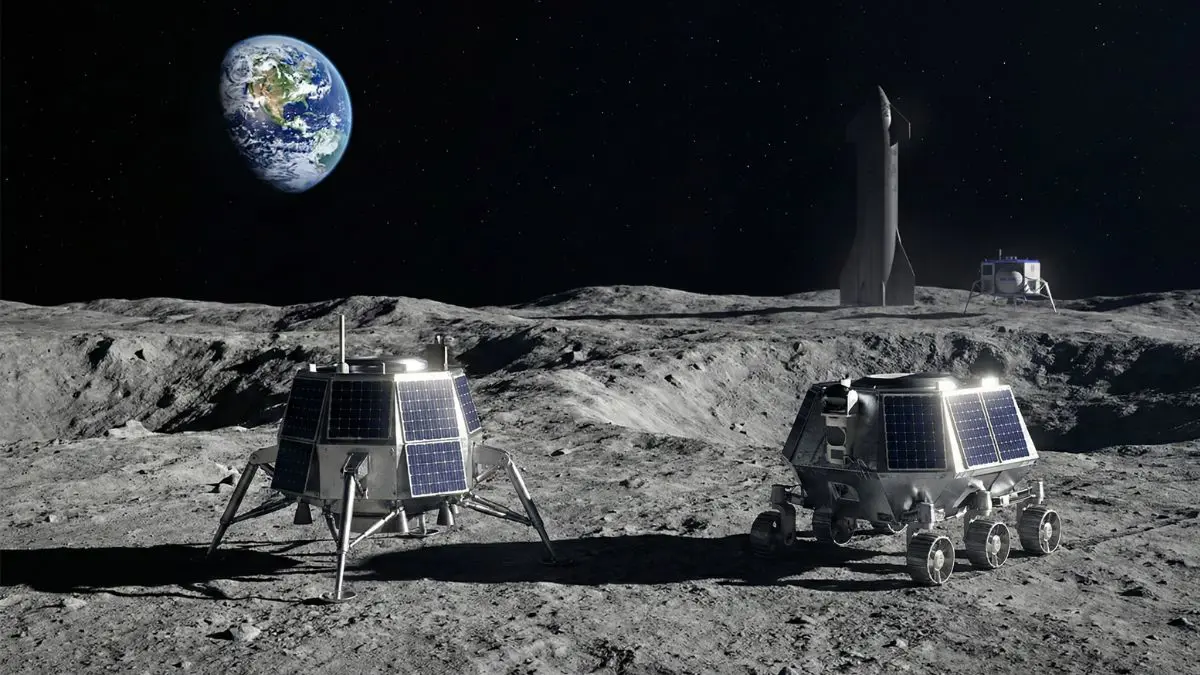
The battle between U.S. space billionaires is intensifying as Elon Musk and Jeff Bezos push their companies deeper into lunar ambitions, aiming to return humans to the Moon ahead of China’s planned 2030 astronaut mission.
With a potential SpaceX IPO looming and U.S. officials urging faster progress under NASA’s Artemis programme, both SpaceX and Blue Origin are sharpening their focus on lunar infrastructure.
Musk pivots toward “Moonbase Alpha”
Musk has recently outlined plans for a lunar base dubbed “Moonbase Alpha,” along with concepts for manufacturing and satellite-launching capabilities positioned on the Moon’s surface. The project would support his broader long-term vision of expanding computing, communications and eventually AI-linked infrastructure beyond Earth.
The renewed push marks a notable shift for SpaceX, which Musk founded in 2002 with the long-term goal of colonising Mars. As recently as last year, Musk had described the Moon as a “distraction” from Mars ambitions.
Now, amid reports that a future SpaceX listing could value the company above $1 trillion, Musk appears keen to reinforce the company’s leadership in next-generation space transport and lunar development.
Bezos doubles down on Blue Moon
Meanwhile, Blue Origin, founded by Bezos, has intensified work on its Blue Moon lunar lander programme.
The company has scaled back parts of its suborbital tourism focus to prioritise lunar systems. An uncrewed Blue Moon mission planned for later this decade is intended as a precursor to astronaut landings under NASA’s Artemis programme.
Blue Origin recently shipped a lunar lander to NASA’s Johnson Space Center in Texas for thermal vacuum testing — a critical milestone before launch readiness.
Bezos has subtly contrasted his strategy with Musk’s faster iteration approach, recently posting an image of a tortoise referencing Aesop’s fable — consistent with Blue Origin’s motto, Gradatim Ferociter (“step by step, ferociously”).
NASA’s Artemis timeline and the China factor
Both SpaceX and Blue Origin are developing lunar landers with billions of dollars in funding from NASA as part of the Artemis programme, which aims to return astronauts to the Moon for the first time since the Apollo missions.
Artemis is designed not only to re-establish a sustained human presence on the Moon but also to prepare for eventual missions to Mars.
The geopolitical backdrop is significant. China has announced plans to land astronauts on the Moon by 2030, prompting U.S. policymakers to view lunar progress as both strategic and symbolic.
NASA has urged contractors to accelerate development timelines as global competition in space intensifies.
Starship’s long to-do list
SpaceX’s fully reusable Starship rocket — selected as NASA’s Human Landing System for early Artemis missions — has conducted multiple test flights since 2023. While progress has been rapid, the vehicle still faces major technical milestones:
- Demonstrating reliable in-orbit refuelling using tanker variants
- Proving precision lunar descent and ascent capabilities
- Certifying life-support and safety systems for crewed missions
A crewed lunar landing before 2030 remains technically ambitious, according to industry analysts.
Investor ripple effects
The Musk-Bezos rivalry is reshaping the broader lunar economy.
Executives across emerging U.S. space startups report rising investor interest as government contracts and private capital flow into lunar logistics, robotics, communications and infrastructure.
If SpaceX or Blue Origin succeeds in establishing early lunar transport or surface systems, they could influence how commercial mining, scientific research and strategic uses of the Moon develop over the coming decades.
Why this matters
The renewed lunar push is not only about prestige — it has long-term commercial and geopolitical implications:
- Lunar infrastructure could underpin future deep-space missions
- Government contracts are reshaping private space valuations
- Early transport dominance may define future commercial access
- Strategic competition with China is accelerating timelines
For investors and policymakers alike, the Moon is increasingly viewed as both a proving ground for deep-space capability and a foundation for the next phase of the space economy.
Summary
Elon Musk and Jeff Bezos are intensifying lunar development efforts as SpaceX and Blue Origin compete to return astronauts to the Moon under NASA’s Artemis programme. With China targeting a 2030 crewed landing, both companies are accelerating lander development and infrastructure plans, raising stakes in the emerging lunar economy.
FAQs
Q1: Why are Musk and Bezos focusing on the Moon?
Both companies are competing to support NASA’s Artemis missions and position themselves in the emerging lunar economy, amid competition with China.
Q2: Has SpaceX abandoned Mars?
No. Mars remains Musk’s long-term objective, though current commercial and geopolitical priorities have increased focus on lunar missions.
Q3: What is Blue Moon?
Blue Moon is Blue Origin’s lunar lander designed to deliver cargo — and eventually astronauts — to the Moon’s surface.
Q4: What is Artemis?
NASA’s Artemis programme aims to return humans to the Moon and establish a sustained lunar presence before future missions to Mars.
Q5: Why is China relevant?
China has announced plans to land astronauts on the Moon by 2030, intensifying strategic competition in space.
Q6: When could astronauts return to the Moon?
NASA targets the late 2020s, though timelines depend on successful testing and certification milestones.

























