Modi’s rooftop solar push slows as lenders and states drag feet
By Axel Miller | 16 Feb 2026
Summary
- Loan bottlenecks and weak state backing slow rooftop solar adoption
- Utilities worry about revenue loss as households shift toward self-generation
- Majority of applications under PM Surya Ghar still under review
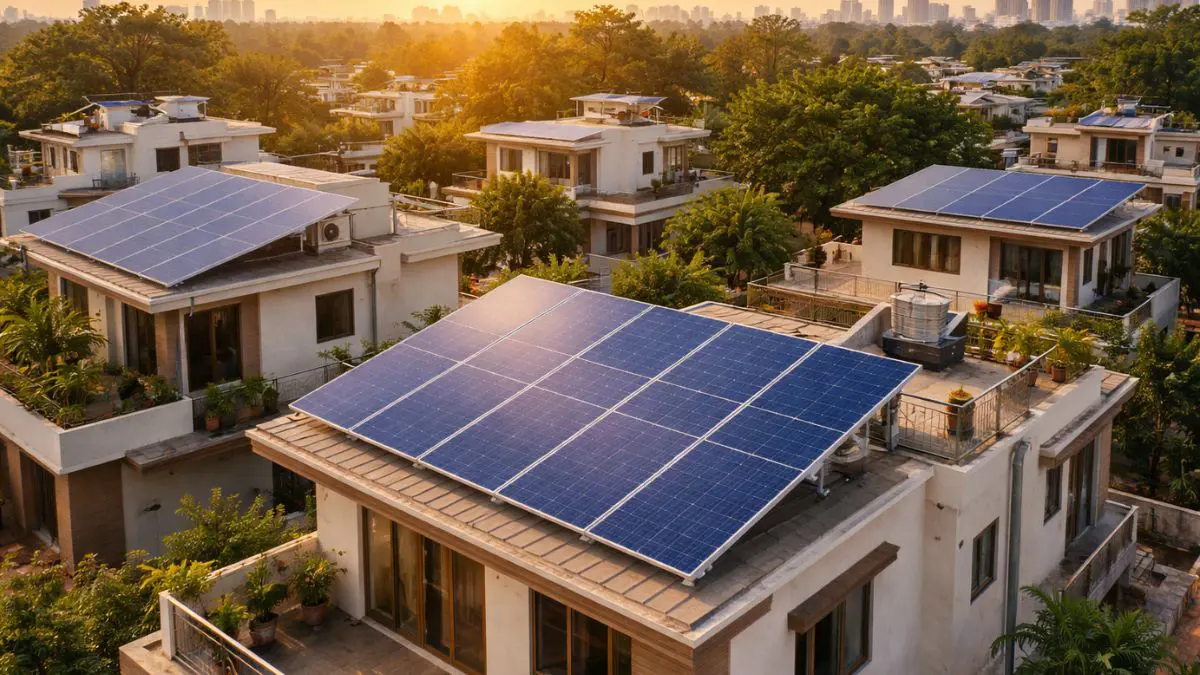
India’s ambitious drive to accelerate rooftop solar adoption is running into practical roadblocks, with delays in bank lending and uneven support from state utilities slowing progress despite generous government subsidies.
The programme — championed by Prime Minister Narendra Modi — is a key pillar of India’s plan to expand clean energy capacity sharply this decade. But implementation challenges suggest the rollout could fall short of near-term targets, potentially slowing reductions in the country’s reliance on coal-fired power.
Subsidies in place, but uptake lags
The residential solar initiative, launched by the Ministry of New and Renewable Energy in early 2024, offers subsidies covering up to 40% of installation costs under the PM Surya Ghar scheme.
Yet installations — more than 2 million households so far — remain below the target of 4 million by March, according to programme data.
Officials say the scheme has benefited millions of households and is helping state utilities manage subsidy burdens by lowering residential electricity bills. Still, a majority of applications remain under review, highlighting administrative and financing hurdles.
Banks cautious amid documentation concerns
A major friction point is access to financing. Banks have slowed approvals or rejected applications due to incomplete documentation, credit concerns, and uncertainties around collateral.
Bank officials argue that standardised paperwork is essential to limit credit risk, noting that repossessing rooftop solar panels in case of default offers limited recovery value.
Vendors on the ground report practical issues — from disputed land titles to missed electricity payments — complicating loan processing, particularly in smaller towns and rural areas.
States and utilities wary of revenue impact
State distribution companies have been hesitant to actively promote rooftop solar, partly because increased self-generation reduces electricity sales — a key revenue stream.
Analysts say the shift is particularly sensitive because higher-income households, which typically consume more electricity, are often the first to adopt rooftop systems. Their reduced grid consumption can leave utilities with a higher share of lower-paying consumers, straining finances.
Clean energy targets at stake
The slowdown comes at a delicate moment for India’s energy transition. The country is targeting 500 gigawatts of non-fossil power capacity by 2030, but delays in distributed solar could complicate that pathway.
If adoption remains sluggish, India may need to rely more heavily on coal generation to meet rising power demand — especially as electricity consumption grows alongside industrial expansion and digital infrastructure build-out.
Why this matters
Rooftop solar is critical for reducing peak demand, cutting transmission losses, and accelerating decarbonisation. Persistent financing and policy bottlenecks highlight the gap between ambitious targets and on-ground execution — a recurring challenge in large-scale energy transitions.
FAQs
Q1: What is the PM Surya Ghar scheme?
A government programme that provides subsidies to households for installing rooftop solar systems.
Q2: Why are rooftop solar installations slowing?
Loan delays, documentation issues, and limited promotion by state utilities are key factors.
Q3: How many applications are pending?
A majority of applications remain under review, reflecting administrative and financing constraints.
Q4: Why are utilities concerned about rooftop solar?
Because it reduces electricity sales, potentially weakening their financial position.
Q5: Does this affect India’s climate goals?
Yes — slower adoption could make it harder to meet clean energy targets and reduce reliance on coal.
Q6: Are banks rejecting loans outright?
Some applications are delayed or rejected due to credit checks, missing documents, or collateral concerns.

























