AI tensions and chip controls dominate Trump-Xi summit in Beijing
By Axel Miller | 13 May 2026
Summary
- Technology rivalry: Artificial intelligence, semiconductor controls, and cybersecurity have emerged as major issues during the Trump-Xi summit in Beijing.
- Nvidia focus: Nvidia CEO Jensen Huang is expected to play a key role in discussions surrounding advanced chip exports and AI infrastructure access.
- Cybersecurity concerns: The United States and China continue to disagree over access to advanced AI systems and the broader governance of frontier AI technologies.
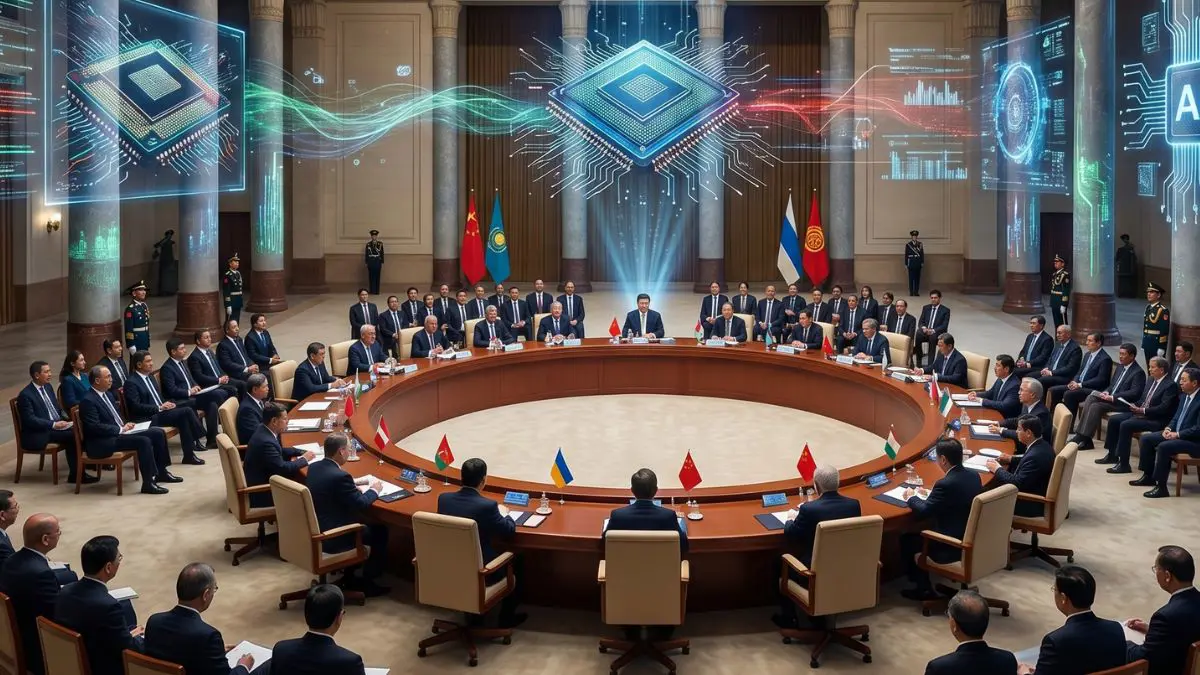
BEIJING, May 13, 2026 — Artificial intelligence and semiconductor restrictions have become central themes at high-level talks between U.S. President Donald Trump and Chinese President Xi Jinping in Beijing, underscoring how technology competition now shapes the broader relationship between the world’s two largest economies.
The summit comes amid continuing disputes over export controls, advanced AI chips, and cybersecurity standards. U.S. officials have increasingly framed advanced artificial intelligence as a national security issue, while Beijing has criticized Washington’s restrictions on semiconductor technology exports.
Nvidia and chip controls take center stage
A major point of attention is the participation of Nvidia CEO Jensen Huang in discussions linked to semiconductor supply chains and AI hardware access.
The United States has tightened export restrictions on advanced chips and lithography technologies in recent years, aiming to limit China’s ability to develop cutting-edge AI systems. China, meanwhile, has accelerated investment in domestic semiconductor production and AI research.
Analysts say Nvidia’s presence highlights the importance of AI computing infrastructure in current trade negotiations, particularly as Chinese companies remain major buyers of AI accelerators and data-center hardware.
Cybersecurity and AI governance tensions
The talks also reflect growing global concern over the use of advanced AI systems in cybersecurity, software development, and critical infrastructure protection.
While companies such as Anthropic and OpenAI continue developing increasingly capable models, governments are debating how access to high-risk AI tools should be managed internationally.
There is no public evidence supporting claims that specific AI models are capable of fully autonomous large-scale cyber operations without human oversight. However, policymakers on both sides increasingly view frontier AI systems as strategic technologies comparable to advanced semiconductors or defense infrastructure.
Trade and technology increasingly intertwined
Officials from both countries are expected to continue discussions on export controls, investment restrictions, and AI safety coordination following the summit.
Analysts say a comprehensive agreement remains unlikely, but both governments appear interested in preventing technology competition from escalating into broader economic or cybersecurity confrontation.
Why this matters
- AI sovereignty: Governments increasingly view advanced AI systems as strategic national assets.
- Semiconductor dependency: AI development depends heavily on access to advanced chips and manufacturing equipment.
- Cybersecurity concerns: Policymakers fear the misuse of AI in software exploitation, disinformation, and critical infrastructure attacks.
- Global supply chains: Technology restrictions between the U.S. and China continue reshaping semiconductor and cloud-computing markets worldwide.
FAQs
Q1. Why is Nvidia important in the U.S.-China AI dispute?
Nvidia produces many of the advanced chips used to train and operate modern AI systems, making it central to global AI infrastructure.
Q2. What are export controls?
Export controls are government restrictions that limit the sale of sensitive technologies, including advanced semiconductors and chipmaking equipment, to specific countries.
Q3. Are the U.S. and China negotiating an AI treaty?
There is no confirmed indication of a formal AI treaty. Current discussions are focused more on risk management, trade restrictions, and communication channels.