India, Ethiopia elevate bilateral ties to ‘strategic partnership’
By Unnikrishnan | 18 Dec 2025
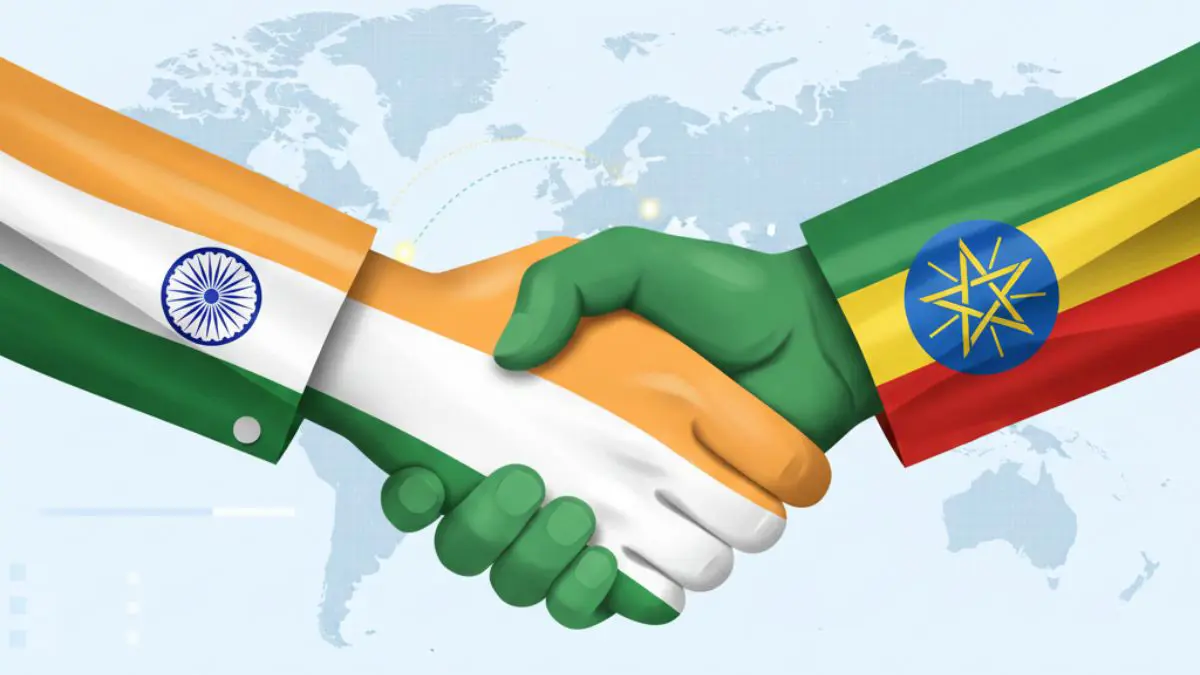
India and Ethiopia have decided to elevate their bilateral relations to a strategic partnership, considering the current level of engagement between the two countries and the importance of the relationship in building an inclusive world. The decision was announced after a meeting between Indian Prime Minister Narendra Modi and his Ethiopian counterpart Dr Abiy Ahmed.
The two leaders agreed that as Global South partners, the two countries must continue to contribute towards building an inclusive world. Prime Minister Modi underlined that it was this understanding that prompted India to take the initiative to welcome the African Union as a G20 member during its presidency of the grouping in 2023.
The two countries are already cooperting in areas of trade and investment, innovation and technology, education and capacity building, and defence as well as the fight against terrorism. Prime Minister Modi expressed India’s willingness to step up collaboration with Ethiopia in the fields of health security, digital health, traditional medicine, Jan Aushadhi Kendra, food security, sustainable agriculture, natural farming, and Agri-tech.
India will also co-operate with Ethiopia in the fields of digital public infrastructure, mining, critical minerals and clean and renewable energy, climate change as also disaster risk management.
The two leaders also agreed on the need for enhanced global cooperation on issues such as climate change, renewable energy and disaster risk reduction while welcoming the role of international organisations such as International Big Cat Alliance (IBCA), Coalition for Disaster Resilient Infrastructure (CDRI), Global Biofuel Alliance (GBA) and International Solar Alliance (ISA).
Indian investors have invested over $5 billion in Ethiopia, especially in key sectors like manufacturing and pharmaceuticals, creating over 75,000 local jobs.
Ethiopia is already a member of the BRICS grouping and as such the two prime ministers reaffirmed their commitment to working together in multilateral fora, including the United Nations, to voice the concerns of the Global South.
Modi also addressed a joint session of Ethiopia’s Parliament.
India and Ethiopia also agreed on the need to expand the level of bilateral trade, which was about $550.19 million in the 2024–25 financial year, even as political interactions and institutional mechanisms have helped sustain engagement outside trade.
The two countries also signed agreement on co-operation and Mutual Administrative Assistance in Custom matters; establishing Data Centre at Ethiopia’s ministry of foreign affairs; co-operation in UN peacekeeping operations and training; debt restructuring in respect of Ethiopia under the G20 Common Framework; doubling of scholarships to Ethiopian scholars under ICCR programme; specialised short term courses to Ethiopian students and professionals in the field of Artificial Intelligence under the ITEC programme as also augmenting the capacity of the Mahatma Gandhi Hospital in Addis Ababa in the fields of maternal healthcare, neonatal care.
Modi arrived in Addis Ababa on the second leg of a three-nation tour after a visit to the Hashemite kingdom of Jordan on 15-16 December. The Indian prime minister visited Jordan’s capital Amman at the invitation of Jordan’s King Abdullah II ibn Al Hussein.
India and Jordan enjoy a warm, long-standing relationship and their mutual engagement span across various areas, including political, economic, defence, security, culture, and education among others.
During bilateral talks, the leaders agreed to expand cooperation between the two countries in areas of mutual interest and to stand together as trusted partners in pursuing development aspirations of both countries.
The leaders also agreed to fully utilise the existing channels of political dialogue between the two countries as well as the various Joint Working Groups in diverse areas.
On the economic side, the two sides agreed to diversify their already strong bilateral trade, which stood at $ 2.3 billion in 2024-25, making India the third largest trading partner of Jordan. They agreed on the need to diversify the trade basket to further enhance bilateral trade. Towards this, they agreed on the early convening of the 11th Trade and Economic Joint Committee in the first half of 2026.
Meanwhile, high-level business forums from the two countries discussed ways to further strengthen and expand trade and economic cooperation between the two countries.
Both leaders underlined the potential for enhanced logistics and economic cooperation between the two countries, taking into account Jordan’s strategic geographic location and its role in the India Middle East Europe economic corridor.
The two sides reviewed bilateral cooperation in the fields of digital technology and education and agreed to collaborate in capacity building and upgrading of digital infrastructure of the India and Jordan Centre of Excellence in Information Technology at the Al Hussein Technical University.
The two sides also discussed the roadmap for collaboration in the field of Digital Public Infrastructure (DPI), in order to ensure a safe, secure, trusted and inclusive digital environment.
India also pointed to the role of capacity building in sustainable development and expressed commitment to continue collaboration in this field through the Indian Technical and Economic Cooperation (ITEC) Programme in various fields, including information technology, agriculture, and healthcare. The Jordanian side appreciated the increase of ITEC slots from 35 to 50 with effect from the current year.
The two sides also committed themselves to work together in areas like healthcare through sharing of expertise, agriculture, with a view to advancing food security and nutrition; water resources management and development and adoption of enabling technologies.
Besides, India and Jordan have agreed to increase collaboration in the field of climate change, environment, sustainable development and renewable energy. Towards this they have signed an MoU on technical cooperation and exchange and training of scientific and technical personnel, organisation of workshops, seminars and working groups, transfer of equipment, know-how and technology on a non-commercial basis as also joint research on subjects of mutual interest.
Other areas of cooperation include cultural exchanges, improving connectivity in fostering bilateral relations. It is an important cornerstone for promotion of trade, investment, tourism, and people-to-people exchanges and helps in cultivating deeper mutual understanding. The two sides also agreed to explore the possibility of enhancing direct connectivity between the two countries.