Chidambaram proposes more spending cuts as twin deficits widen
03 Oct 2013
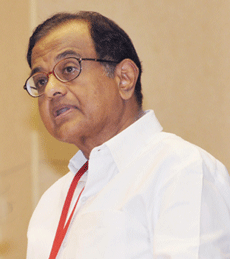 Finance minister P Chidambaram has hinted at more cuts in government non-Plan spending so as to meet the fiscal deficit target of 4.8 per cent for the current financial year.
Chidambaram's proposals to cut government spending and private captive consumption, such as that of gold, comes after the fiscal deficit numbers reached three-fourths of the budget estimate in the first five months of the fiscal and trade deficit hit 4.9 per cent of the country's gross domestic product.
He attributed the spike in fiscal deficit to a front-loading of government spending, with government borrowing already touching 74.6 per cent.
"The planned expenditure is running at around 4-5 per cent ahead of last year. We deliberately front-loaded it. Now we are planning a compression in the non-planned expenditure."
"All this will play out over the year. We don't look at it like a still photograph. Things will even out over the year and I am confident we will remain below the red line of 4.8 percent," he said.
Speaking on the sidelines of a function organised by J&K Bank in Srinagar, Chidambaram, however, expressed confidence of a better growth show in the second quarter, after a dismal show in the first quarter, when the economy clipped at a poor 4.4 per cent.
While core sector growth in August hit a seven-month high of 3.7 per cent in August, Chidambaram said it cannot still be seen as a return to the growth path.
"It is too early to say all that. All I can say is that the core sector is showing growth, exports are showing robust growth. Credit growth to select industries is showing good growth."
"For example, credit to two-wheelers sales, small and medium enterprises sector, retail, all that is growing. I think it's too early to call it a victory yet, let us wait for a couple of months. But I am sure that the second half will be better than the first half," he said.
He said the 4.9 per cent current account number in fiscal first quarter was due mainly to a spurt in gold imports, especially in April and May, and this could decline with a sharp dip in bullion imports in the second quarter.
CAD for April-June was $21.8 billion or 4.9 per cent of GDP. The government's target for the financial year is $70 billion or 3.7 per cent of GDP.
"I think we will be comfortably below $70 billion. At the moment, I will stick to $70 billion. When the second-quarter numbers are announced, then I will give a better number," Chidambaram said.

























