AI war shifts gears: chips, drones reshape global power
By Cygnus | 27 Mar 2026
Summary
Recent developments in China’s AI chips, drone strategy, and technology access highlight a shift in global competition.
The changes point to a more fragmented and complex technology landscape with implications for businesses and governments.
Key takeaway
The global AI race is increasingly shaped not just by innovation, but by access to chips, scalable technologies like drones, and the resilience of supply chains.
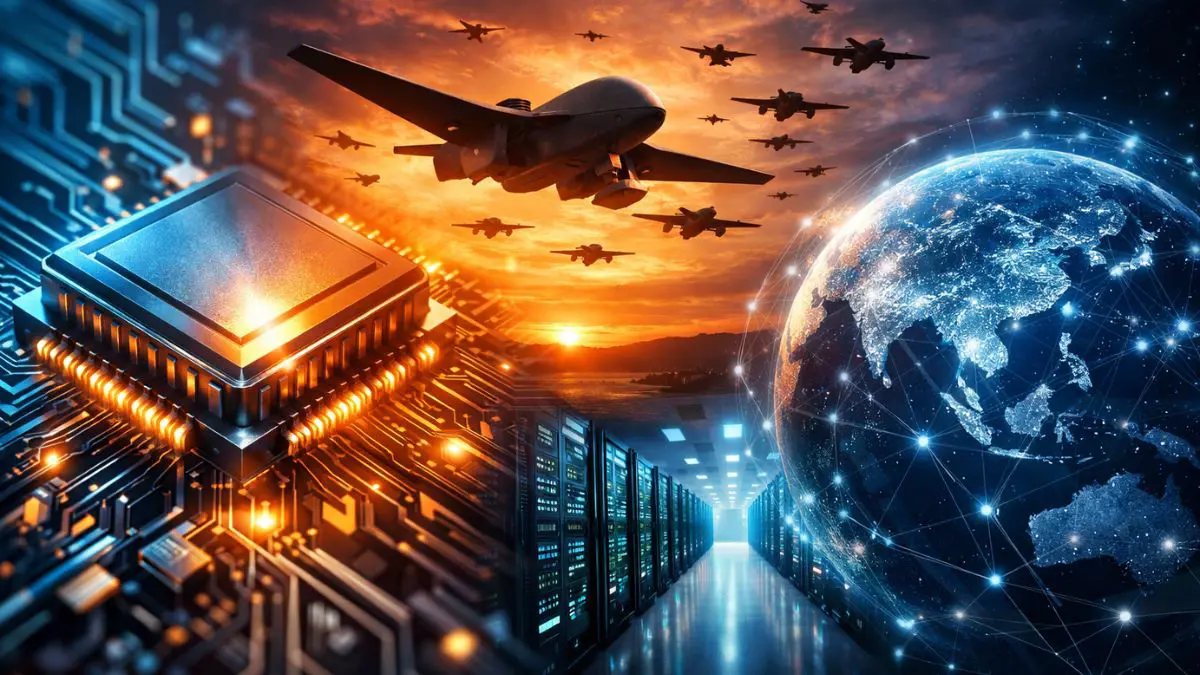
SHANGHAI / WASHINGTON, March 27, 2026 — The global race for artificial intelligence leadership is entering a new phase, shaped not only by advanced chips but also by evolving military tactics and increasingly complex supply chains.
A series of recent developments—from China’s deployment of converted fighter jets as drones to the growing adoption of domestic AI chips—suggest that technological competition is expanding beyond innovation toward resilience and scale.
Together, these shifts point to a broader transformation in how countries build, deploy, and protect their technological capabilities.
From precision to scale: the evolution of drone strategy
One of the clearest changes is in military planning. China has deployed older fighter jets converted into drones near the Taiwan Strait, according to recent reporting.
These systems are not the most advanced, but their strength lies in scale. By deploying large volumes of relatively low-cost drones, military planners can place sustained pressure on air defense systems, forcing opponents such as Taiwan to use expensive interceptor missiles.
This approach reflects a wider shift in modern warfare—from reliance on a limited number of high-end systems toward strategies built on scale, cost efficiency, and operational flexibility.
The chip battlefield: AI hardware as a strategic asset
At the same time, competition for AI hardware is intensifying. Chinese technology firms are increasingly turning to domestic suppliers such as Huawei, as restrictions limit access to advanced processors from companies like Nvidia.
This shift highlights how semiconductors have become a central element of economic and technological strategy. AI chips are no longer just components—they underpin cloud computing, automation, and next-generation digital services.
As a result, countries are investing more heavily in building local capabilities, reducing reliance on external suppliers, and securing access to critical technologies.
Supply chains under pressure
Efforts to control the flow of advanced technology are also exposing structural challenges. Recent findings show that high-performance servers from Super Micro Computer were acquired by Chinese institutions through third-party resellers.
While such transactions occur within complex global distribution networks, they underscore the difficulty of enforcing export controls on modular hardware that can pass through multiple intermediaries.
For policymakers, this highlights a fundamental issue: technology supply chains are global, interconnected, and difficult to segment.
A shift in global research collaboration
The impact extends beyond hardware. Academic and research collaboration is also being affected.
Chinese researchers recently withdrew from a major international AI conference after restrictions were placed on submissions from certain entities. The move reflects growing tension in how knowledge is shared and governed in the AI ecosystem.
As collaboration becomes more constrained, parallel research environments may begin to emerge, potentially shaping future innovation pathways and standards.
What this means for business and investors
For companies and investors, these developments signal a more complex and evolving operating environment:
- Supply chains may need to adapt to multiple regulatory frameworks
- Technology sourcing could shift toward regional or domestic ecosystems
- Costs may increase as infrastructure is duplicated across markets
- Risk management will increasingly include geopolitical considerations
Rather than operating within a single global system, businesses may need to navigate parallel ecosystems shaped by policy, security priorities, and access to resources.
A more fragmented, but evolving ecosystem
These developments do not point to a complete separation of global technology systems. However, they do suggest growing fragmentation, as regions prioritize resilience, control, and strategic independence.
As artificial intelligence continues to reshape economies and industries, balancing openness with security is likely to remain a defining challenge.
Why this matters
- Highlights a shift toward scale-driven and cost-efficient military strategies
- Reinforces the role of AI chips as critical strategic infrastructure
- Exposes challenges in enforcing global technology controls
- Signals potential fragmentation in AI research and collaboration ecosystems
FAQs
Q1: Why is AI becoming central to geopolitical competition?
AI supports critical sectors such as defense, finance, and digital infrastructure, making it strategically important.
Q2: What is changing in modern warfare?
There is a shift toward deploying large volumes of lower-cost systems, such as drones, alongside traditional capabilities.
Q3: Why are AI chips so important?
They power advanced computing systems required for AI development, automation, and large-scale data processing.
Q4: Are global technology systems splitting apart?
Not entirely, but increasing fragmentation is emerging due to regulatory and geopolitical pressures.
Q5: What should businesses take away from this?
Companies need to adapt to a more complex environment shaped by evolving supply chains and regulatory frameworks.

























