Technology - general
Pakistan becomes associate member of CERN
20 Dec 2014
Big-data analysis reveals gene sharing in mice
19 Dec 2014

Engineers pasteurise eggs in the shell
18 Dec 2014
The invention uses radio frequency (RF) energy to transmit heat through the shell and into the yolk while the egg rotates. Streams of cool water simultaneously flow over the egg to protect the delicate white. Researchers then bathe the egg in hot water to complete the pasteurisation process
Researchers develop novel lithium-sulphur
18 Dec 2014
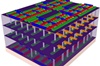
Stanford team combines logic, memory to build a 'high-rise' chip
17 Dec 2014
Stanford researchers are building layers of logic and memory into skyscraper chips that are smaller, faster, cheaper – and taller

Detecting gases wirelessly and cheaply
By Anne Trafton | MIT News Office | 13 Dec 2014
MIT chemists have devised a new way to wirelessly detect hazardous gases and environmental pollutants, using a simple sensor that can be read by a smartphone
Study shows embryos can learn
12 Dec 2014
Chemists fabricate novel rewritable paper
06 Dec 2014


The human eye can see ‘invisible’ infrared light
06 Dec 2014
Any science textbook will tell you we can't see infrared light, since it is outside the visual spectrum, but an international team of researchers has found that under certain conditions the retina can sense infrared light

Researchers create world’s fastest camera
05 Dec 2014
This camera doesn’t look like a Kodak or Cannon; rather, it is a series of devices envisioned to work with high-powered microscopes and telescopes to capture dynamic natural and physical phenomena

Computer model enables design of complex DNA shapes
By Anne Trafton | MIT News Office | 04 Dec 2014
MIT biological engineers have created a new computer model that allows them to design the most complex three-dimensional DNA shapes ever produced
Horses, rhinos originated in India; study
03 Dec 2014
New device could make large biological circuits practical
By Researchers have made great progress in recent yea | 01 Dec 2014

Engineers invent high-tech mirror to beam heat away from buildings into space
01 Dec 2014
A new ultra-thin multi-layered material can cool buildings without air conditioning by radiating warmth from inside the buildings into space while also reflecting sunlight to reduce incoming heat


Latest articles









Featured articles

The decoupling paradox: Why Wall Street keeps funding AI despite $100 oil
By Axel Miller | 11 May 2026
AI infrastructure stocks continue rallying despite $100 oil as investors bet on productivity gains and semiconductor demand in 2026.

Hybrid bonding gains attention as AI chip packaging demand grows
By Cygnus | 23 Apr 2026
Hybrid bonding is driving AI chip packaging demand as backend technologies gain importance in the semiconductor supply chain.

The agentic transition: how enterprises are scaling AI from pilot to profit
By Cygnus | 22 Apr 2026
AI has entered its execution era. Discover how companies like Valeo and Microsoft are scaling agentic AI systems—from copilots to autonomous workflows driving real business impact.

Post-splashdown: What Artemis II taught us about the ‘deep space wall’
By Axel Miller | 15 Apr 2026
Artemis II splashdown marks a breakthrough in deep space exploration. Discover AVATAR radiation data, Orion’s distance record, and insights shaping NASA’s 2028 Moon mission.

Can aviation go green? The multi-billion dollar race for sustainable fuel
By Cygnus | 10 Apr 2026
Airlines are racing to adopt sustainable aviation fuel, but limited supply and high costs challenge the future of green aviation.

The battery race: who will control the future of electric vehicles?
By Axel Miller | 08 Apr 2026
The global battery race is reshaping the electric vehicle industry, with China, the US, and Europe competing for control over supply chains and technology.

AI vs governments: Who controls the future of intelligence?
By Cygnus | 07 Apr 2026
Governments and AI companies like OpenAI and Anthropic are shaping the future of intelligence amid rising policy conflicts and global competition.

Strait of Hormuz: how one chokepoint controls the global economy
By Axel Miller | 06 Apr 2026
The Strait of Hormuz is a critical global chokepoint. Learn how disruptions impact oil prices, shipping, and the global economy.

The $2 trillion AI infrastructure race: Who will control global compute?
By Cygnus | 06 Apr 2026
AI spending is set to exceed $2 trillion in 2026, driving a global race in data centers, chips, and energy infrastructure.






