Stanford scientists use microbes to make 'clean' methane
By By Mark Shwartz | 25 Jul 2012
Microbes that convert electricity into methane gas could become an important source of renewable energy, according to scientists from Stanford and Pennsylvania State universities.
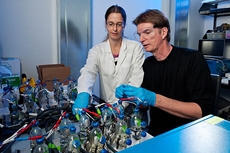 |
| Post-doctoral fellow Svenja Lohner, left, and Professor Alfred Spormann. Their research, along with the work of others, could help solve one of the biggest challenges for large-scale renewable energy: What to do with surplus electricity generated by photovoltaic power stations and wind farms. |
Researchers at both campuses are raising colonies of microorganisms, called methanogens, which have the remarkable ability to turn electrical energy into pure methane – the key ingredient in natural gas. The scientists' goal is to create large microbial factories that will transform clean electricity from solar, wind or nuclear power into renewable methane fuel and other valuable chemical compounds for industry.
"Most of today's methane is derived from natural gas, a fossil fuel," said Alfred Spormann, a professor of chemical engineering and of civil and environmental engineering at Stanford. "And many important organic molecules used in industry are made from petroleum. Our microbial approach would eliminate the need for using these fossil resources."
While methane itself is a formidable greenhouse gas, 20 times more potent than CO2, the microbial methane would be safely captured and stored, thus minimising leakage into the atmosphere, Spormann said.
"The whole microbial process is carbon neutral," he explained. "All of the CO2 released during combustion is derived from the atmosphere, and all of the electrical energy comes from renewables or nuclear power, which are also CO2-free."
Methane-producing microbes, he added, could help solve one of the biggest challenges for large-scale renewable energy: What to do with surplus electricity generated by photovoltaic power stations and wind farms.

























