Scientists calculate carbon footprint of grid-scale battery technologies
By By Mark Shwartz | 12 Mar 2013
Americans take electrical power for granted whenever they flip on a light switch. But the growing use of solar and wind power in the United States makes the on-demand delivery of electricity more challenging.
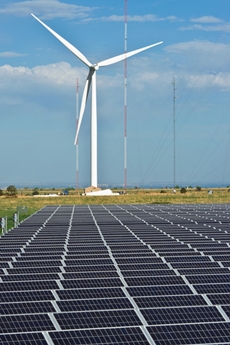 |
| Solar and wind power pose a challenge for the U.S. electrical grid, which lacks the capacity to store surplus clean electricity and deliver it on demand. Researchers are developing grid-scale storage batteries, but the fossil fuel required to build these technologies could negate some of the environmental benefits of new solar and wind farms, say Stanford scientists. (Photo: Dennis Schroeder / NREL) |
A key problem is that the US electrical grid has virtually no storage capacity, so grid operators can't stockpile surplus clean energy and deliver it at night, or when the wind isn't blowing.
To provide more flexibility in managing the grid, researchers have begun developing new batteries and other large-scale storage devices. But the fossil fuel required to build these technologies could negate some of the environmental benefits of installing new solar and wind farms, according to Stanford University scientists.
"We calculated how much energy it will cost society to build storage on future power grids that are heavily supplied by renewable resources," said Charles Barnhart, a postdoctoral fellow at Stanford's Global Climate and Energy Project (GCEP) and lead author of the study. "It turns out that that grid storage is energetically expensive, and some technologies, like lead-acid batteries, will require more energy to build and maintain than others."
The results have been published in a recent online edition of the journal Energy & Environmental Science.
Most of the electricity produced in the United States comes from coal- and natural gas-fired power plants. Only about 3 per cent is generated from wind, solar, hydroelectric and other renewable sources. The Stanford study considers a future US grid where up to 80 per cent of the electricity comes from renewables.

























