Researchers closing in on developing a digital eye
07 Aug 2008
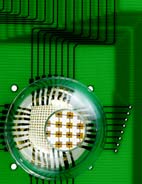 |
| Photo courtesy: John Rogers Photograph of the electronic eye camera after integration with a transparent hemispherical cap and a simple, single component imaging lens. |
With funding from the National Science Foundation and the US Department of Energy, John Rogers, the Flory-Founder chair professor of materials science and engineering at Illinois, and Yonggang Huang of Northwestern University in Evanston, Illinois, demonstrated a digital camera on a curved surface that has the size, shape and layout of a human eye.
The work opens new possibilities for advanced camera design. It also foreshadows artificial retinas for bionic eyes similar in concept to those in the movie ''Terminator'' and other popular science fiction.
The researchers say the curved shape vastly improved the field of vision, bringing the whole picture into focus. The device could be used to make better imaging equipment, such as curved sensors to monitor brain activity that follow the contours of the brain. It could even be used in the development of an artificial retina or a bionic eye, which future research could enable being connected to the brain.
The camera has been made using an array of single-crystalline silicon detectors and electronics, configured in a stretchable, interconnected mesh.
''Conformally wrapping surfaces with stretchable sheets of optoelectronics provides a practical route for integrating well-developed planar device technologies onto complex curvilinear objects,'' said Rogers.
''This approach allows us to put electronics in places where we couldn't before,'' Rogers said. ''We can now, for the first time, move device design beyond the flatland constraints of conventional wafer-based systems.
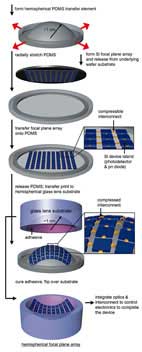 |
| Photo courtesy: John Rogers Schematic illustration of steps for using compressible silicon focal plane arrays and hemispherical, elastomeric transfer elements to fabricate electronic eye cameras. |
To make the camera, the researchers begin by moulding a thin rubber membrane in the shape of a hemisphere. The rubber membrane is then stretched with a specialised mechanical stage to form a flat drumhead.
Next, a prefabricated focal plane array and associated electronics - created by conventional planar processing - are transferred from a silicon wafer to the tensioned, drumhead membrane.
When the tension is released, the membrane returns to its original shape. This process compresses the focal plane array, causing specially designed electrical interconnects to delaminate from the rubber surface and form arcs, pinned on the ends by detector pixels. These deformations accommodate strains associated with the planar to hemispherical transformation, without stressing the silicon, as confirmed by mechanics modeling performed by researchers at Northwestern.
The array package is then transfer printed to a matching hemispherical glass substrate. Attaching a lens and connecting the camera to external electronics completes the assembly. The camera has the size and shape of a human eye.
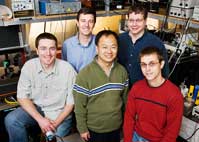 |
| Photo by L. Brian Stauffer The camera was designed by John Rogers (back left), the Flory-Founder Chair Professor of Materials Science and Engineering, and his research group: (clockwwise from back right) Joe Geddes, Mark Stoykovich, Heung Cho Ko and Viktor Malyarchuk, all postdoctoral researchers. |
Over the last 20 years, many research groups have pursued electronic eye systems of this general type, but none has achieved a working camera.
''Optics simulations and imaging studies show that these systems provide a much broader field of view, improved illumination uniformity and fewer aberrations than flat cameras with similar imaging lenses,'' said Rogers, who also is a researcher at the Beckman Institute and at the university's Frederick Seitz Materials Research Laboratory.
''Hemispherical detector arrays are also much better suited for use as retinal implants than flat detectors,'' Rogers said. ''The ability to wrap high quality silicon devices onto complex surfaces and biological tissues adds very interesting and powerful capabilities to electronic and optoelectronic device design, with many new application possibilities.''

























