Nvidia signals deeper push into CPUs as AI workloads evolve
By Cygnus | 26 Feb 2026
Summary
Nvidia is emphasizing the growing importance of CPUs alongside GPUs as artificial intelligence shifts toward inference and real-time applications, positioning the company to compete more directly with established processor makers.
SAN FRANCISCO, Feb. 26, 2026 — Nvidia CEO Jensen Huang highlighted the company’s expanding focus on central processing units, underscoring its ambition to play a larger role in the broader data-center computing stack as AI usage patterns evolve.
Speaking after the company’s quarterly results, Huang said Nvidia’s CPU roadmap is designed to complement its dominant GPU business as customers build increasingly complex AI infrastructure.
Shift toward full-stack computing
Nvidia’s growth has been driven primarily by demand for GPUs used to train large AI models. However, as more AI systems move into production, workloads such as inference, orchestration, and data processing are increasing the importance of CPUs within data-center architectures.
The company’s Grace-series processors are aimed at handling high-performance computing tasks and improving memory bandwidth, enabling tighter integration with GPUs.
Rising competition in data-center chips
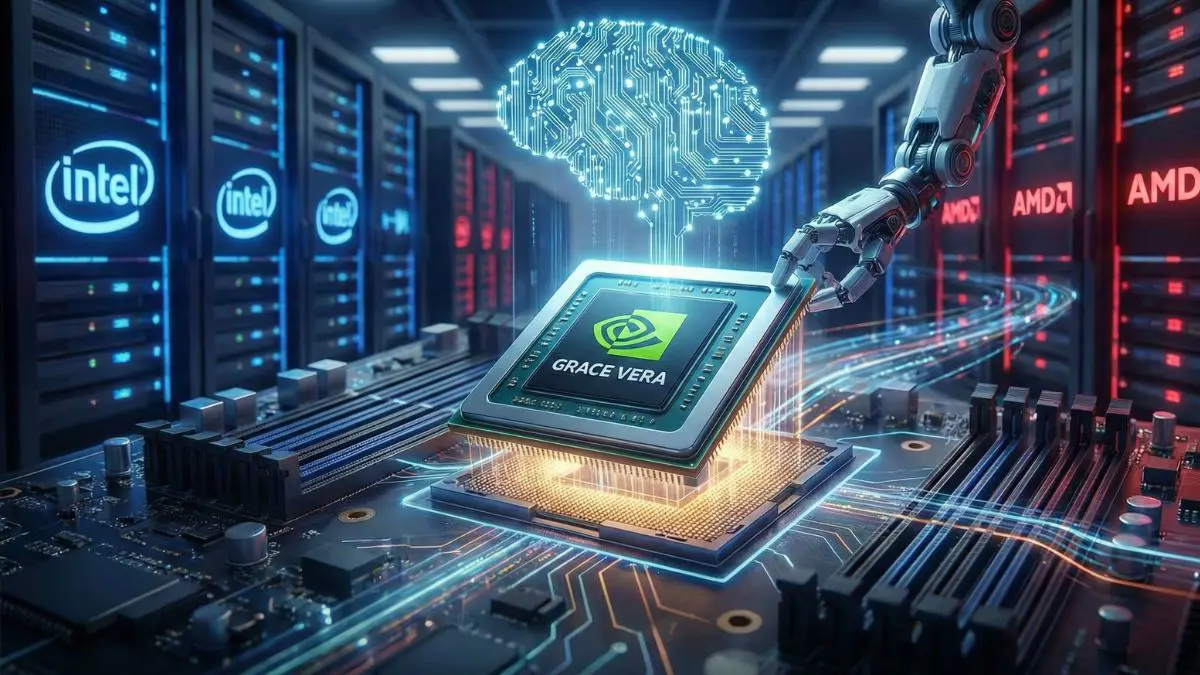
A deeper push into CPUs puts Nvidia in more direct competition with established server-chip leaders, including Intel and AMD, both of which continue to expand their own AI-focused processor offerings.
Industry analysts say hyperscale cloud providers are increasingly seeking diversified chip strategies to balance performance, power consumption, and supply-chain resilience.
Evolving AI infrastructure
As AI deployments scale, data-center designs are becoming more heterogeneous, combining CPUs, GPUs, networking hardware, and specialized accelerators.
Executives across the sector expect demand to remain strong as enterprises integrate AI into applications ranging from automation to analytics.
Nvidia is expected to provide further details on its roadmap at upcoming industry events.
Why this matters
Competition across the full computing stack is intensifying as AI becomes a core driver of data-center investment.
Nvidia’s move signals a broader industry trend: companies are seeking to control more components of AI infrastructure to optimize performance and capture a larger share of spending.
FAQs
Q1. Why is Nvidia emphasizing CPUs now?
Because AI deployments require both accelerators and general-purpose processors to handle different workloads.
Q2. Does this mean Nvidia is abandoning GPUs?
No. GPUs remain central to its strategy, with CPUs positioned as complementary components.
Q3. Who are Nvidia’s main competitors in CPUs?
Intel and AMD dominate the server CPU market.
Q4. How could this affect data-center design?
Systems may increasingly use tightly integrated CPU-GPU architectures.
Q5. What’s next for Nvidia?
The company is expected to share more details on future chip plans at upcoming conferences.

























