Receptor proteins may hold clues to antibiotic resistance in MRSA bacteria
16 May 2013
Scientists have identified four new proteins that act as receptors for an essential signalling molecule in bacteria such as methicillin-resistant staphylococcus aureus (MRSA).
The receptors are thought to play an important role in enabling bacteria to respond to their environment. Their discovery provides scientists with vital clues in the hunt for new antibiotics, which are increasingly in need as bacteria become resistant to existing treatments.
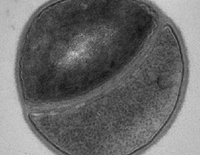 |
| Methicillin-resistant Staphylococcus aureus |
The bacterium Staphylococcus aureus causes life-threatening diseases in hospital patients and in previously healthy people. Methicillin-resistant S. aureus strains, known as MRSA, are especially difficult to treat due to their antibiotic resistance.
Scientists are eager to understand the chemical processes that allow bacteria to respond to changes in their environment. Interfering with these processes could help prevent bacteria from surviving inside the human body.
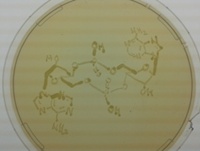 |
| The strucure of c-di-AMP - depicted in a culture of Staphylococcus aureus |
A recently discovered molecule called c-di-AMP appears to play a vital role as a messenger in many bacteria, carrying signals between parts of the cell. There is evidence that strains with more c-di-AMP are more resistant to antibiotics. But until now, very little was known about what processes in cells are regulated by c-di-AMP.
''What makes this molecule special and a bit different from others like it is that there is now growing evidence that many bacteria need to produce this molecule in order to grow and divide, so it's an essential component of the cell,'' says Dr Angelika Gründling from the MRC Centre for Molecular Bacteriology and Infection at Imperial College London, who led the new study in collaboration with Dr Vincent Lee from the University of Maryland, USA.
Signalling molecules work by binding to specific receptor proteins, which act as switches for cellular functions. ''So the real key to understanding what pathways are controlled by c-di-AMP, and therefore help us to understand why this molecule is important for the growth of bacteria, is to find these target proteins,'' Dr Gründling said.
In the new study, published today in Proceedings of the National Academy of Sciences, Dr Gründling and her colleagues pinpointed four receptors for c-di-AMP in S. aureus. Similar proteins are found in many other bacterial species, several of which can also cause disease in humans.
Dr Rebecca Corrigan, a postdoctoral researcher at Imperial who worked on the study, says, ''This is really exciting news for the field, as we now have the first clues as to which cellular pathways we need to focus on in order to understand why this molecule is so important for the growth of S. aureus.''
''We hope that these findings can be exploited in the future to develop new antibiotics that target the cellular pathways controlled by c-di-AMP. Such drugs might be effective against a broad spectrum of bacteria.''
Dr Gründling addd, ''There is now also increasing evidence that S. aureus strains with high c-di-AMP levels show increased resistance to methicillin-type antibiotics. This indicates that c-di-AMP might help bacteria to better survive antibiotic treatment and by inhibiting c-di-AMP synthesis we might be able to increase the effectiveness of certain antibiotics.''









.webp)