Lensless imaging of whole biological cells with soft x-rays
19 May 2010
A team of scientists working at beamline 9.0.1 of the advanced light source (ALS) at the US Department of Energy's Lawrence Berkeley National Laboratory has used x-ray diffraction microscopy to make images of whole yeast cells, achieving the highest resolution -11 to 13 nanometers (billionths of a meter) - ever obtained with this method for biological specimens.
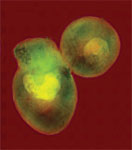 |
| A pair of yeast cells imaged at very high resolution using coherent soft x-rays at the Advanced Light Source's beamline 9.0.1. The coherent (laser-like) beam of penetrating x-rays allows a computer to reconstruct the cells' internal structures from a diffraction pattern, without focusing the light with a lens. |
Their success indicates that full 3-D tomography of whole cells at equivalent resolution should soon be possible.
''We have demonstrated that lensless imaging techniques can achieve very high resolution while overcoming the limitations of x-ray optics - limitations that include requiring 20 to 50 times the radiation exposure to get a magnified image of the sample,'' says Chris Jacobsen, formerly of Stony Brook University, now of Argonne National Laboratory and Northwestern University, who designed the lensless-imaging research programme at beamline 9.0.1. ''While at present it takes us a long time to image a single specimen - and full 3-D imaging of hydrated cells will take even more work - this is a big step in the right direction.''
Three-dimensional imaging of whole cells under conditions close to those in nature, namely a hydrated (watery) environment, is already done at the National Centre for X-Ray Tomography at ALS beamline 2.1, under the direction of Carolyn Larabell of Berkeley Lab's Physical Biosciences Division, where large numbers of cells can be processed in a short time at resolutions of 40 to 60 nanometers. The ability to increase resolution to the 10-nanometer range would significantly advance research in both biology and materials sciences.
''Ten-nanometer resolution is easy to achieve with an electron microscope,'' says Janos Kirz of the ALS, co-designer with Jacobsen of the lensless imaging programme. ''The problem is that electron microscopy is limited to very thin samples, a few hundred nanometers or less - so you can't use it to look through a whole cell.''
While x-rays have the ability to look deep into thick specimens, or right through them, imaging with a lens has its own problems. Even the best x-ray microscope lenses (concentric circles of metal known as Fresnel zone plates), can't focus x-rays with high efficiency, so to get an image means using such intense radiation that it more quickly damages biological specimens. At the same time, the geometry of the highest-resolution zone plates makes for an extremely narrow depth of focus.

























