Private investment strengthens as India records 7.8% GDP growth in Q1
By Cygnus | 01 Sep 2026
Summary
- Strong economic growth: India’s economy expanded 7.8% year-on-year in the April-June quarter of FY27, exceeding the Reserve Bank of India’s 7% projection.
- Investment gains momentum: Gross fixed capital formation rose 11.9%, with its share of GDP increasing to 34.3% from 31.4% a year earlier.
- Broad-based credit growth: Non-food bank credit grew 19.1% year-on-year in July, while credit to industry and services recorded growth of 20% and 22.9%, respectively.
NEW DELHI, September 1, 2026 — India’s economy grew 7.8% year-on-year in the April-June quarter of the 2026-27 financial year, supported by strong investment, household consumption, manufacturing and services despite global economic pressures.
The growth rate exceeded the Reserve Bank of India’s projection of 7% for the quarter and marked an improvement from the 6.9% expansion recorded in the corresponding period a year earlier.
Data released by the Ministry of Statistics and Programme Implementation showed that real GDP reached ₹81.36 lakh crore during the first quarter, while nominal GDP grew 10.3% to ₹88.27 lakh crore. Real gross value added rose 8.2%.
Prime Minister Narendra Modi described the growth performance as an important achievement, saying the economy had remained resilient despite oil price shocks, supply-chain disruptions and global uncertainty.
Investment emerges as a key growth driver
Investment was among the strongest contributors to growth during the quarter.
Gross fixed capital formation, a key measure of investment in physical assets, increased 11.9% year-on-year in real terms. Its share of GDP rose to 34.3%, compared with 31.4% in the first quarter of the previous financial year. The investment growth rate was the highest in 13 quarters, according to data reported following the GDP release.
Private final consumption expenditure also remained resilient, growing 7.1% during the quarter, while exports increased 12%.
The figures point to a broader mix of growth drivers, with investment and consumption both supporting economic activity alongside manufacturing and services.
Credit growth supports investment activity
The latest banking data also showed a broad-based increase in credit demand.
Non-food bank credit grew 19.1% year-on-year in the fortnight ended July 31, compared with 9.9% growth during the corresponding period a year earlier.
Credit to industry increased 20%, while services-sector credit rose 22.9%. The acceleration was seen across several sectors, indicating stronger financing activity among businesses and service providers.
The growth in bank lending provides additional support for the view that investment activity is expanding across different parts of the economy.
Public spending and private investment
Government capital expenditure has played an important role in building infrastructure and supporting investment activity in recent years.
The latest GDP data suggests that capital formation is continuing to make a significant contribution to economic growth, alongside household consumption and government expenditure.
Economists and policymakers have closely watched whether stronger public infrastructure spending would encourage greater private-sector investment. The rise in gross fixed capital formation during the April-June quarter points to continued momentum in overall investment, although the available GDP data does not separate the contribution of private and public investment.
Investment activity is being supported across infrastructure, manufacturing, technology and services, according to recent economic and industry reporting.
Technology and manufacturing attract capital
India’s investment cycle is increasingly extending into sectors linked to digital infrastructure and advanced manufacturing.
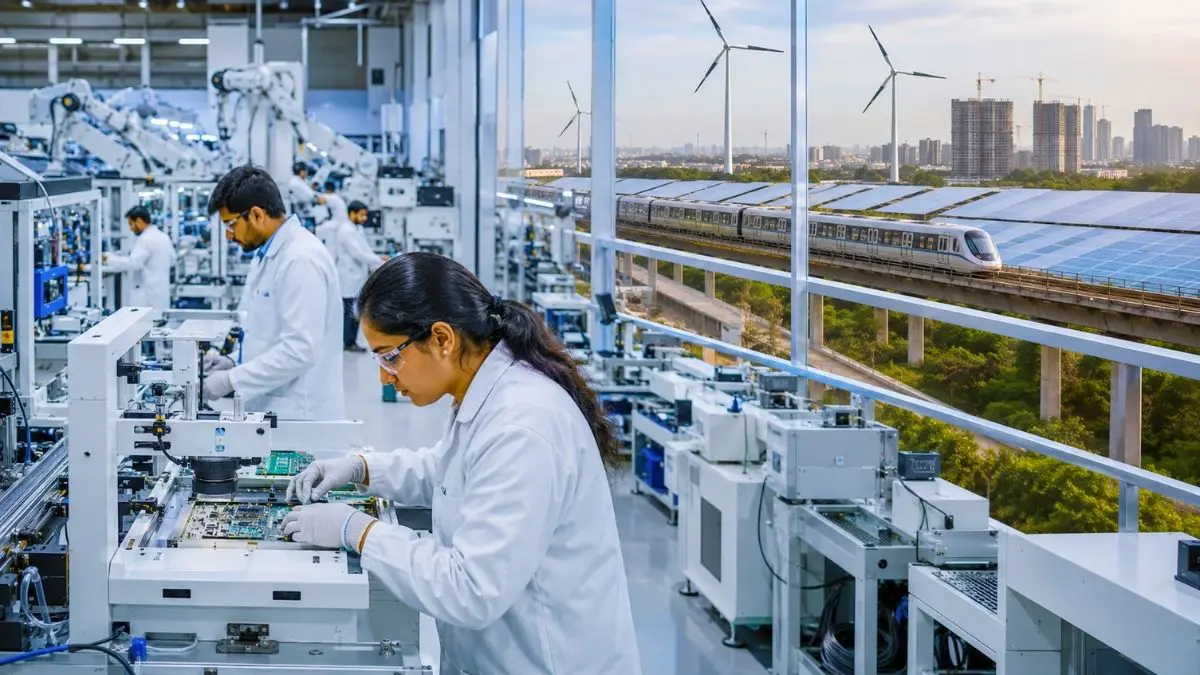
Data centres, semiconductor projects, renewable energy, electronics manufacturing and defence production are among the areas attracting substantial investment commitments.
At the same time, traditional infrastructure and manufacturing remain important components of capital expenditure.
The expansion of investment in technology-intensive sectors reflects India’s efforts to strengthen domestic manufacturing capabilities and increase its role in global supply chains. However, the scale and timing of individual projects can vary significantly depending on financing conditions, regulatory approvals and market demand.
Manufacturing and services support growth
Manufacturing and services were among the strongest contributors to the economy’s performance during the quarter.
Manufacturing expanded 9.2%, while services grew 10%, according to the latest economic data.
The combination of stronger investment, resilient consumption and growth in major service industries helped offset weaker performance in some other sectors.
The government said the first-quarter performance showed that domestic demand and productive sectors had continued to support the economy despite geopolitical tensions and uncertainty in global trade and commodity markets.
Risks remain for the growth outlook
Despite the strong start to FY27, risks to the outlook remain.
Higher energy prices, global geopolitical tensions, supply-chain disruptions and currency movements could affect economic conditions in the coming quarters.
The sustainability of investment growth will also depend on domestic demand, corporate confidence and global financing conditions.
Another challenge is ensuring that rising investment generates sufficient employment opportunities, particularly as companies increase spending on automation and technology-intensive infrastructure.
India’s strong first-quarter growth provides a positive start to the financial year, but the pace of expansion in subsequent quarters will depend on both domestic conditions and developments in the global economy.
Why this matters
- Investment momentum: The 11.9% growth in gross fixed capital formation highlights the increasing importance of capital expenditure in India’s economic expansion.
- Broader growth base: Investment, household consumption, manufacturing and services all contributed to the strong first-quarter performance.
- Strong credit demand: Bank lending growth across industry and services points to expanding financing activity in the economy.
- Technology investment: Digital infrastructure, advanced manufacturing, semiconductors and clean energy are emerging as important areas for future capital deployment.
- External risks: Energy prices, global trade conditions and geopolitical tensions remain important risks for the growth outlook.
FAQs
Q1: What drove India’s 7.8% GDP growth in the April-June quarter?
India’s growth was supported by strong investment, household consumption, manufacturing and services. Gross fixed capital formation increased 11.9%, while private consumption grew 7.1%.
Q2: How much did investment grow in Q1 FY27?
Gross fixed capital formation grew 11.9% year-on-year in real terms. Its share of GDP increased to 34.3%, compared with 31.4% in the same quarter of the previous year.
Q3: How fast is bank credit growing in India?
Non-food bank credit grew 19.1% year-on-year in the fortnight ended July 31, 2026. Credit to industry grew 20%, while services-sector credit increased 22.9%.
Q4: Which sectors supported India’s economic growth?
Manufacturing, services, investment and household consumption were among the key contributors to growth during the first quarter of FY27.
Q5: What risks could affect future growth?
Higher energy prices, geopolitical tensions, supply-chain disruptions, currency movements and weaker global demand could affect India’s growth outlook.