New defence acquisition policy to promote private domestic manufacturers
28 Oct 2009
New Delhi: Set to roll out on 1 November this year, India's new Defence Procurement Policy (DPP) will allow domestic private companies to bid for equipment tenders for the armed forces alongside public sector defence units (PSDU) as well as the Defence Research and Development Organisation (DRDO). Under terms of policy, domestic manufacturers may subsequently join hands with foreign manufacturers for co-production through joint ventures.
The new DPP 2009 replaces the existing DPP 2008.
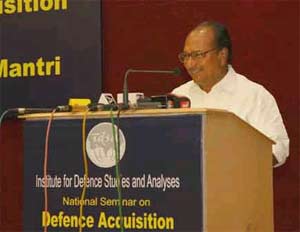 |
| The Defence Minister, Shri A. K. Antony delivering the keynote address to the National Seminar on Defence Acquisition, organised by the Institute for Defence Studies and Analyses (IDSA) in New Delhi |
Addressing a seminar on defence acquisition here defence minister AK Antony said the current review of the DPP was aimed at ''promoting and facilitating'' Indian industry and ''transparency and integrity'' in defence acquisitions. The review of the DPP would henceforth be carried out on an annual basis instead of once in two years, as previous.
''The current review is primarily focused on two essential areas of promoting and facilitating wide participation of defence industry and enabling transparency and integrity in all acquisitions,'' Antony said.
Under terms of the DPP 2008, tender papers were issued only to foreign vendors which were required to transfer technology to an Indian defence firm, called production agency, under a 'Buy and Make' category.
''This does not promote setting up joint venture or co-production arrangements in India by big foreign original equipment manufacturers. In order to obviate the above shortcoming, the Buy and Make (Indian) category is being introduced, which allows issue of request for proposals to Indian industries having requisite financial and technical capabilities to absorb technology and undertake indigenous manufacture through transfer of technology and not through research and development,'' the minister said.

























