New pacemaker that synchronises heart rate with breathing
01 Jul 2014
Pacemaker research from the Universities of Bath and Bristol could revolutionise the lives of over 750,000 people who live with heart failure in the UK.
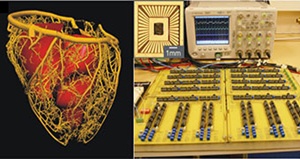 | |
| A new type of pacemaker being developed by researchers at the Universities of Bath and Bristol works to modulate its pulses to match patients' breathing rate. Within the next five years the device could help to extend the lives of over 750,000 people who live with heart failure in the UK. Auckland Bioengineering Institute |
The British Heart Foundation (BHF) is awarding funding to researchers developing a new type of heart pacemaker that modulates its pulses to match breathing rates.
During 2012-13 in England, more than 40,000 patients had a pacemaker fitted.
Currently, the pulses from pacemakers are set at a constant rate when fitted, which doesn't replicate the natural beating of the human heart.
The normal healthy variation in heart rate during breathing is lost in cardiovascular disease and is an indicator for sleep apnoea, cardiac arrhythmia, hypertension, heart failure and sudden cardiac death.
The novel device being developed by scientists at the Universities of Bath and Bristol uses synthetic neural technology to restore this natural variation of heart rate with lung inflation, and is targeted towards patients with heart failure.
The device works by saving the heart energy, improving its pumping efficiency and enhancing blood flow to the heart muscle itself. Pre-clinical trials suggest the device increases the pumping ability by 25 per cent, which is expected to extend the life of patients with heart failure.
One aim of the project is to miniaturise the pacemaker device to the size of a postage stamp and to develop an implant that could be used in humans within five years.
Dr Alain Nogaret, senior lecturer in physics at the University of Bath, explains, ''This is a multidisciplinary project with strong translational value. By combining fundamental science and nanotechnology we will be able to deliver a unique treatment for heart failure which is not currently addressed by mainstream cardiac rhythm management devices.''
The research team has already patented the technology and is working with NHS consultants at the Bristol Heart Institute, the University of California at San Diego and the University of Auckland.
Professor Julian Paton, from the University of Bristol, adds, ''We've known for almost 80 years that the heart beat is modulated by breathing but we have never fully understood the benefits this brings. The generous new funding from the BHF will allow us to reinstate this natural occurring synchrony between heart rate and breathing and understand how it brings therapy to hearts that are failing.''
Professor Jeremy Pearson, associate medical director at the BHF, says, ''This study is a novel and exciting first step towards a new generation of smarter pacemakers. More and more people are living with heart failure so our funding in this area is crucial. The work from this innovative research team could have a real impact on heart failure patients' lives in the future.''
It is expected that this technology can also be applied to other areas of brain research, including prosthetics and potentially to stimulate the rebuilding of nerves following a stroke.