Himalayan rocks shed light on India’s drift speed mystery
07 May 2015
Relics and rocks recovered in the Himalayas have shed light on a long-stand puzzle regarding the high speed with which India crashed into Eurasia 50 million years ago, according to geologists from the Massachusetts Institute of Technology (MIT).
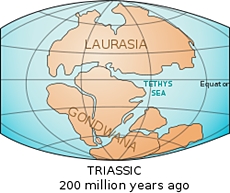 More than 140 million years ago, India was part of an immense supercontinent called Gondwana, which covered much of the Southern Hemisphere.
India, broke away from supercontinent – which also comprised present day Madagascar, Arabia, Africa and South America -120 million years ago, drifting at an unremarkable speed of 5 centimetres a year. India's drift suddenly accelerated to 150 centimetres per year 80 million years ago and continued at the same pace for 30 million years, when it collided with Eurasia giving rise to the Himalayas.
The study, published in Nature Geoscience, pointed to a combination of two subduction zones that were responsible for the speed at which India kept moving northwards after splitting from Gondwana in the southern hemisphere.
Double subduction zones refer to the mantle of the earth where the edge of one tectonic plate sank under another plate, and pulled along any connected landmasses owing to twice the pulling power.
''In earth science, it's hard to be completely sure of anything," said Leigh Royden, professor of geology and geophysics in MIT's Department of Earth, Atmospheric and Planetary Sciences. ''But there are so many pieces of evidence that all fit together here that we're pretty convinced.''
According to the geologists, two such sinking plates would provide twice the pulling power, doubling India's drift velocity.
The team found relics of what might have been two subduction zones by sampling and dating rocks from the Himalayan region.
After developing a model for a double subduction system, the geologists determined that India's ancient drift velocity could have depended on two factors within the system - the width of the subducting plates, and the distance between them.
Plates that were relatively narrow and far apart, would cause India to drift at a faster rate.
India was sent adrift across the Tethys Ocean, an immense body of water that separated Gondwana from Eurasia.
(Read more: India drift )