Chinese study shows Tibetan glaciers feeding Bhramaputra rapidly shrinking
22 May 2014
Glaciers in the Qinghai-Tibet Plateau, the watershed for several Himalayan rivers, have been shrunk by 15 per cent in the past three decades and the situation could worsen in future due to global warming, Chinese scientists said on Wednesday.
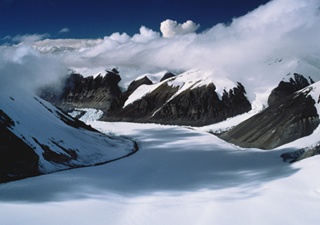 | |
| Disappearing Water Supply Rongbuk Glacier in Tibet, as seen from Mount Everest. This and other glaciers in the area are losing more ice than scientists have realized, research shows. Glaciers serve as vital water resources for people living in the region and their disappearance could spell trouble |
Glaciers on the plateau and surrounding areas have shrunk by 15 per cent from 53,000 to 45,000 sq km over the past three decades, according to a report by the Institute of Tibetan Plateau Research of the Chinese Academy of Sciences (CAS).
As the highest place in the world's mid-latitude regions, the plateau is more likely to get affected by global warming, they said. Tibet is the chief source home of several Himalayan rivers including the Brahmaputra.
The report follows hard on the heels of research released early this week that shows glaciers in the Nepal region fragmenting as the coverage area shrinks.
Unindustrialised Nepal has complained that it is suffering because of unbridled pollution by the ecologically uncurbed industrialisation of its neighbours, including India which seems to be digging its own environmental grave. (See: Unbridled industrialisation leading to Himalayan eco-disaster, new study confirms).
"Glaciers in the plateau have been shrinking since the 20th century and sped up since the 1990s," said Kang Shichang, a state laboratory director with the Cold and Arid Regions Environmental and Engineering Research Institute of CAS.
"More and bigger cracks have appeared in ice at regions of an altitude above 6,300 metres in Mount Qomolangma (Mt Everest), a sign of rapidly melting glaciers," he said.
China has more than 46,000 glaciers, mainly in the Qinghai-Tibet Plateau. They are a reliable indicator of climate change, and easy for scientists to observe, state-run Xinhua news agency reported.
Kang said retreating glaciers have impacted meltwater rivers and led to more glacier-lake outbursts.
"It can increase water flow of major rivers in the short term, but in the long run, a continuation of the retreat will eventually deplete the glacial ice and substantially reduce or eliminate runoff," Shichang said.
In environmental concerns as in industrialisation, China is forging far ahead of its neighbour and would-be Asian rival – one cannot envisage Indian planners ever admitting that the course they are pursuing, including building mega-dams in ecologically and seismically sensitive areas is a formula for future disaster.