Bioengineers at harvard's Wyss institute successfully replicate nature's design principles to create customized nanofabrics
03 Jun 2010
In Nature, cells and tissues assemble and organize themselves within a matrix of protein fibers that ultimately determines their structure and function, such as the elasticity of skin and the contractility of heart tissue. These natural design principles have now been successfully replicated in the lab by bioengineers at the Wyss Institute for Biologically Inspired Engineering and the School of Engineering and Applied Sciences (SEAS) at Harvard University.
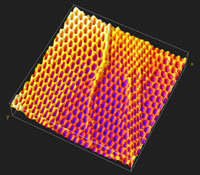 These bioengineers have developed a new technology that can be used to regenerate heart and other tissues and to make nanometer-thick fabrics that are both strong and extremely elastic. The key breakthrough came in the development of a matrix that can assemble itself through interaction with a thermosensitive surface. The protein composition of that matrix can be customized to generate specific properties, and the nanofabric can then be lifted off as a sheet by altering temperature.
"To date it has been very difficult to replicate this extracellular matrix using manmade materials," said Adam W. Feinberg, a Postdoctoral Fellow at Harvard University who will be an Assistant Professor at Carnegie Mellon University in the fall. "But we thought if cells can build this matrix at the surface of their membranes, maybe we can build it ourselves on a surface too. We were thrilled to see that we could."
Feinberg is the lead author of "Surface-Initiated Assembly of Protein Nanofabrics," which appears in the current issue of Nano Letters, a publication of the American Chemical Society. Coauthor Kit Parker is a core faculty member of the Wyss Institute, the Thomas D. Cabot Associate Professor of Applied Science and Associate Professor of Bioengineering at SEAS, and a member of the Harvard Stem Cell Institute.
In the area of tissue regeneration, their technology, which is termed protein nanofabrics, represents a significant step forward. Current methods for regenerating tissue typically involve using synthetic polymers to create a scaffolding. But this approach can cause negative side effects as the polymers degrade. By contrast, nanofabrics are made from the same proteins as normal tissue, and thus the body can degrade them with no ill effects once they are no longer needed. Initial results have produced strands of heart muscle similar to the papillary muscle, which may lead to new strategies for repair and regeneration throughout the heart.
"With nanofabrics, we can control thread count, orientation, and composition, and that capability allows us to create novel tissue engineering scaffolds that direct regeneration," said Parker. "It also enables us to exploit the nanoscale properties of these proteins in new ways beyond medical applications. There are a broad range of applications for this technology using natural, or designer, synthetic proteins."