New device improves skin cancer detection
13 Aug 2014
Researchers in the Cockrell School of Engineering at The University of Texas at Austin (UT Austin) have designed an optical device that may reduce the number of unnecessary biopsies by offering a fast, comprehensive, non-invasive and lower-cost solution to detect melanoma and other skin cancer lesions.
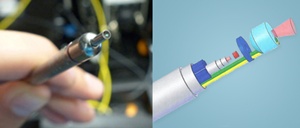 | |
| The left is a photo of the pen-sized 3-in-1 spectroscopy system. The right panel shows a view of the probel assembly with optical elements, such as filters, fibers and front lens. Credit: Review of Scientific Instruments/Eric Marple, EmVision LLC. |
The new device may detect cancerous skin lesions early on, leading to better treatment outcomes and ultimately saving lives.
James Tunnell, an associate professor in the Department of Biomedical Engineering, led a team of researchers to develop a probe that combines three unique ways of using light to measure the properties of skin tissue. The researchers have begun testing their 3-in-1 device in clinical trials and are partnering with funding agencies and startup companies to help bring the device to dermatologists.
Previous research efforts have tried combining spectroscopic techniques to aid in skin cancer detection, but the UT Austin team is the first to put three techniques in a single probe that would be inexpensive enough to be used widely in clinics and doctors' offices.
Tunnell and his colleagues combined Raman spectroscopy, diffuse reflectance spectroscopy and laser-induced fluorescence spectroscopy to create a more complete picture of a skin lesion. By revealing information invisible to the human eye, the probe could offer a faster, better screening tool for cancer and eliminate many biopsies.
''Skin is a natural organ to apply imaging and spectroscopy devices to because of its easy access,'' Tunnell says.
The probe itself is about the size of a pen, and the spectroscopic and computer equipment that supports it fits neatly onto a portable utility cart that can be wheeled between rooms. Each reading takes about 4.5 seconds to perform.
The researchers describe the skin cancer probe in a new paper published 5 August in the journal Review of Scientific Instruments. In addition to Tunnell, Manu Sharma, former post-doctorate student at the Cockrell School; Eric Marple of EmVision LLC; and Jason Reichenberg of the University of Texas Southwestern Medical Center co-authored the study.
Skin cancers of all types are the most common forms of cancer in North America. Melanoma, the most deadly form of skin cancer, is one of the leading causes of cancer death, killing nearly 10,000 people every year in the United States.
Currently, the only definitive way to diagnose skin cancer is to perform a biopsy, in which doctors remove a suspect skin lesion and then examine the stained tissue under a microscope to look for cancerous cells.
Determining which lesions to biopsy is an imprecise art, however, and for every case of skin cancer detected there are about 25 negative biopsies performed, translating to a cost of $6 billion to the US health care system, according to estimations performed by the researchers.
Tunnell believes the new probe developed by his team could eventually help reduce the high number and cost of negative biopsies by giving a clear picture of which skin lesions are most likely cancerous.
As normal skin becomes cancerous, cell nuclei enlarge, the top layers of skin can thicken and the skin cells can increase their consumption of oxygen and become disorganised, Tunnell says. The changes alter the way light interacts with the tissue.
To detect all these changes requires multiple spectroscopic techniques. For example, diffuse optical spectroscopy is sensitive to absorption by proteins, such as hemoglobin. Raman spectroscopy is sensitive to vibrational modes of chemical bonds, such as those found in connective tissues, lipids and cell nuclei.
Most devices have been at the research stage for the past 10 years or so, but several are now undergoing clinical development, including the researchers' 3-in-1 device.
''This probe, which is able to combine all three spectral modalities, is the next critical step to translating spectroscopic technology to the clinic,'' Tunnell says.
The study was funded in part by the Community Foundation of North Central Wisconsin and the National Institutes of Health.

























