Research reveals novel aspects of virus-fighting protein
By By Eric Gershon | 17 Oct 2011
1
Researchers at Yale University have for the first time described how a key protein involved in detecting and fighting viral infection interacts with invading viral molecules and stimulates an immune response. The protein, called RIG-I, has been the subject of intensive study worldwide, but its molecular structure was unknown until now.
The Yale team's observations provide striking new detail about the ways the immune systems of humans and other animals combat disease, and could open new focus areas for the developers of drugs for many diseases, from the common flu to Hepatitis C to cancer.
''Knowing RIG-I's anatomy gives us the opportunity for structure-based drug design,'' said Anna Pyle, professor of molecular, cellular and developmental biology at Yale who was the project's principal investigator. The paper was published on Oct 13 online in the journal Cell.
The Yale team's findings complement simultaneously released work by other researchers who captured different structural snapshots of RIG-I. "Taken together, the studies provide a complete description of early RIG-I activation and response upon viral infection," Pyle said.
RIG-I (pronounced RIG-EYE) stands for retinoic acid-inducible gene I.
Pyle's team focuses on the structure and function of a large family of proteins that includes RIG-I and which function as molecular motors in the cell. Upon binding RNA, these nanomachines move around, sending signals within the cell or creeping along cellular filaments. The paper describes in fine detail the crystalised structure of RIG-I as it engages with viral RNA, showing how the protein recognises and encases the double-stranded RNA and kick-starts the immune response.
The Cell paper notes major mechanical components of RIG-I for the first time, and describes how these parts coordinate to attach and respond to viral RNA. The structural analysis reveals the molecular basis for mechanical communication among the protein's various parts.
The new findings have implications for understanding the functions of the broader protein family of which RIG-I is a member, and thus for many aspects of RNA metabolism.
''The number one goal now is to figure out the exact role of ATP hydrolysis in the process of RIG-I signaling,'' said Pyle, who also is an investigator with the Howard Hughes Medical Institute. The Institute provided funding for this research.
ATP hydrolysis is the process by which the energy necessary for biochemical processes is released.
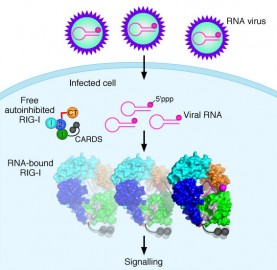 |
| Cellular surveillance protein RIG-I captures viral RNA and alerts the host immune system. |
''Knowing RIG-I's anatomy gives us the opportunity for structure-based drug design,'' said Anna Pyle, professor of molecular, cellular and developmental biology at Yale who was the project's principal investigator. The paper was published on Oct 13 online in the journal Cell.
The Yale team's findings complement simultaneously released work by other researchers who captured different structural snapshots of RIG-I. "Taken together, the studies provide a complete description of early RIG-I activation and response upon viral infection," Pyle said.
RIG-I (pronounced RIG-EYE) stands for retinoic acid-inducible gene I.
Pyle's team focuses on the structure and function of a large family of proteins that includes RIG-I and which function as molecular motors in the cell. Upon binding RNA, these nanomachines move around, sending signals within the cell or creeping along cellular filaments. The paper describes in fine detail the crystalised structure of RIG-I as it engages with viral RNA, showing how the protein recognises and encases the double-stranded RNA and kick-starts the immune response.
The Cell paper notes major mechanical components of RIG-I for the first time, and describes how these parts coordinate to attach and respond to viral RNA. The structural analysis reveals the molecular basis for mechanical communication among the protein's various parts.
The new findings have implications for understanding the functions of the broader protein family of which RIG-I is a member, and thus for many aspects of RNA metabolism.
''The number one goal now is to figure out the exact role of ATP hydrolysis in the process of RIG-I signaling,'' said Pyle, who also is an investigator with the Howard Hughes Medical Institute. The Institute provided funding for this research.
ATP hydrolysis is the process by which the energy necessary for biochemical processes is released.

























