Bat's ears tuned to treating all smooth flat surfaces as water
04 Nov 2010
For a bat's echolocation system, all smooth horizontal surfaces are water - even when they look, smell and feel differently
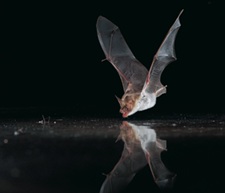 For bats any smooth, horizontal surface is water. Even so if vision, olfaction or touch tells them it is actually a metal, plastic or wooden plate. Bats therefore rely more on their ears than on any other sensory system.
This is due to how smooth surfaces reflect the echolocation calls of bats: they act just like mirrors. In nature there are no other extended, smooth surfaces, so these mirror properties prove to be a reliable feature for recognition of water surfaces.
Scientists from the Max Planck Institute for Ornithology in Seewiesen investigated this phenomenon in 15 different species from three big bat families and found that all tried to drink from smooth plates. In addition they found that this acoustic recognition of water is innate. (Published in Nature Communications November, 2nd 2010).
Water is important for bats to get a drink. However many species also use rivers, lakes or ponds for foraging as water insects are soft and easily digestible. In addition prey is easily detectable with echolocation as the water surface acts like a mirror, reflecting the calls back almost completely. Only if there is an insect on the surface, it reflects back an echo.
In their study Stefan Greif and Björn Siemers from the Max Planck Institute for Ornithology simulated water surfaces in a large flight room and offered the bats a smooth and a structured plate each from either metal, wood or plastic. In weak red illumination the researchers observed whether the bats would fall for this trick and try to drink from the smooth plate.









.webp)