India’s Great Nicobar project clears key hurdle, positioning Bay of Bengal as strategic trade hub
By Axel Miller | 17 Feb 2026
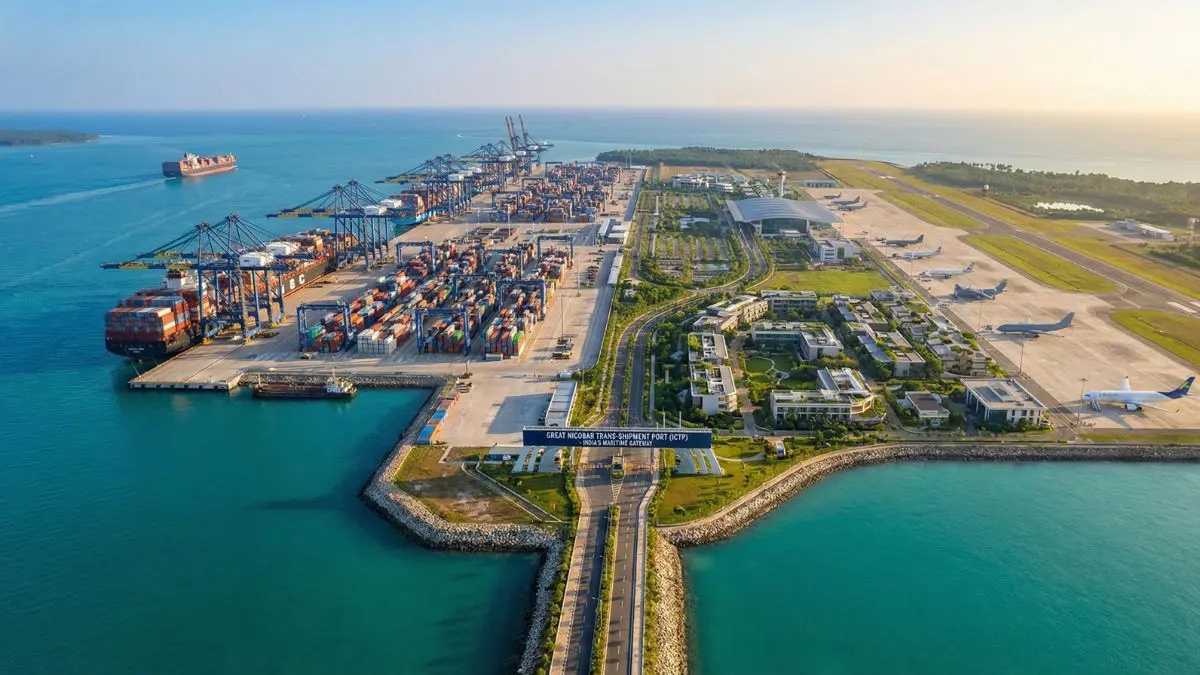
Summary
India’s ₹90,000-crore Great Nicobar mega-infrastructure project has cleared a major legal hurdle after the National Green Tribunal upheld environmental approvals with conditions in February 2026. Anchored by a proposed international container transshipment port at Galathea Bay, the initiative aims to strengthen India’s maritime presence near the Malacca Strait and reduce reliance on foreign cargo hubs.
A mega project with strategic depth
The Great Nicobar development is a large, multi-component initiative covering roughly 166 sq km and designed to combine commercial infrastructure with strategic capabilities.
- International Container Transshipment Port (ICTP): The deep-water port is expected to be developed in phases, with initial capacity around 4 million TEUs and long-term expansion plans significantly higher.
- Dual-use infrastructure: Plans include a civil-military airport, power facilities, and an integrated township, reflecting both economic and security priorities.
- Strategic ownership: The project is structured to maintain majority domestic control, reinforcing its status as critical national infrastructure.
The “Malacca edge”: geography as a strategic asset
Great Nicobar’s proximity — roughly 40 nautical miles from the Malacca Strait — places it near one of the world’s busiest shipping corridors.
- Reducing transshipment dependence: A significant share of India-bound cargo is currently handled at foreign hubs such as Colombo and Singapore.
- Natural deep draft: Galathea Bay’s deep waters make it suitable for large container vessels with limited dredging requirements.
Economic rationale: strengthening India’s logistics chain
The project aims to address long-standing gaps in India’s maritime infrastructure:
- Lower logistics costs by enabling direct handling of large vessels.
- Retention of port-related revenue through domestic transshipment services.
- Network strategy alongside other major ports to improve India’s position on global shipping routes.
Strategic dimension in a competitive region
Beyond commerce, the project is widely viewed as a key component of India’s maritime strategy in the eastern Indian Ocean. The location near the Malacca Strait enhances surveillance and logistical reach, aligning with broader regional security objectives.
Environmental and social safeguards
The tribunal’s clearance came with conditions related to coastal regulation compliance and environmental protections, reflecting ongoing concerns about ecological impact and indigenous communities. Debate around sustainability and tribal welfare is expected to remain part of the project’s implementation phase.
FAQs
Q1: What is the primary goal of the Great Nicobar project?
To create a major transshipment hub and strategic infrastructure node that reduces dependence on foreign ports while strengthening India’s maritime presence.
Q2: When is the port expected to become operational?
Initial phases are targeted toward the latter part of this decade, subject to construction timelines.
Q3: Why is the location strategically important?
Its proximity to the Malacca Strait places it close to one of the world’s busiest sea lanes.
Q4: Are environmental concerns resolved?
No. While approvals have been upheld, the project remains subject to safeguards and continued scrutiny.