Power minister highlights energy security as India expands non-fossil capacity
By Axel Miller | 20 Mar 2026
Summary
Power Minister Manohar Lal Khattar stresses energy security amid rising demand and global uncertainties.
Government data shows improvement in financial performance of power distribution companies (DISCOMs), though sector-wide profitability remains uneven.
India continues to expand non-fossil fuel power capacity toward its 2030 target, with peak demand expected to rise further.
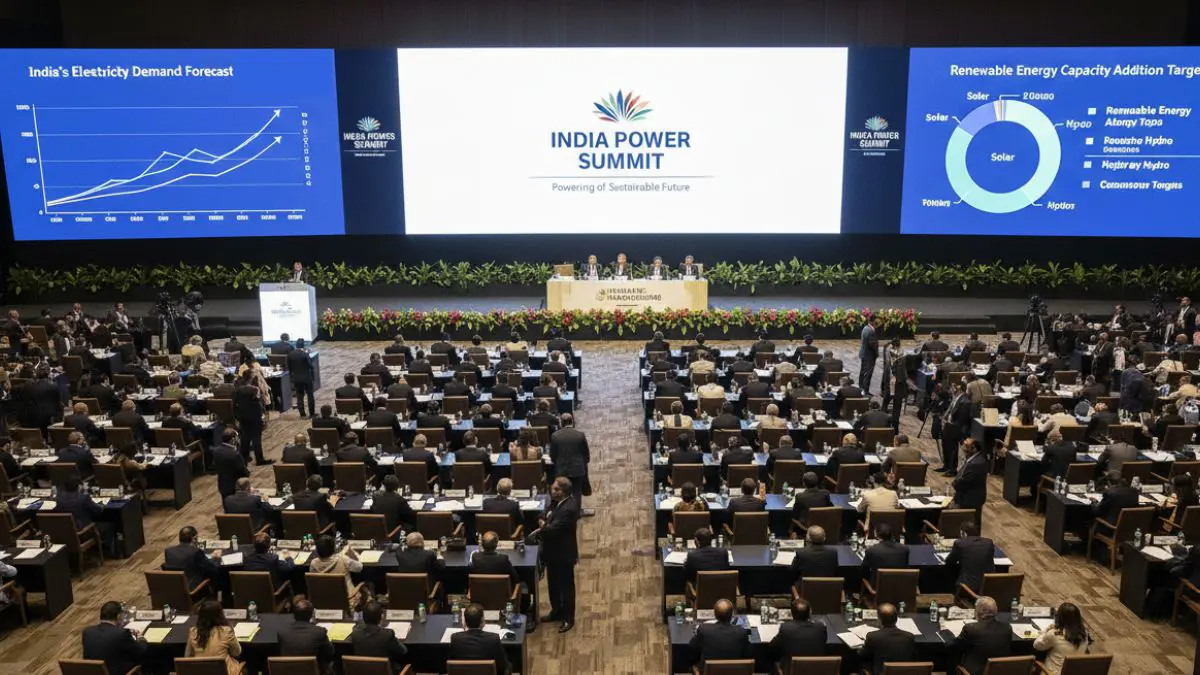
NEW DELHI, March 20, 2026 — India’s Power Minister Manohar Lal Khattar highlighted the need to strengthen energy security as the country expands its electricity capacity and navigates rising demand.
Speaking at an industry event in New Delhi, the minister said India’s power sector has made significant progress in improving supply reliability and increasing the share of non-fossil fuel capacity, while cautioning that global uncertainties underscore the importance of domestic resilience.
India has set a target of achieving 50% of its installed electricity capacity from non-fossil fuel sources by 2030, and officials say capacity additions in renewables and nuclear energy are progressing toward that goal.
DISCOM performance improves
Government assessments, including recent ratings of power distribution utilities, indicate improvements in operational efficiency and financial health for several DISCOMs.
Losses have narrowed in recent years due to measures such as tariff rationalisation, improved billing efficiency and government support schemes. However, the sector as a whole continues to face structural challenges, including payment delays and high aggregate technical and commercial (AT&C) losses in some regions.
Rising demand outlook
India’s electricity demand is expected to grow steadily, with peak demand projected to increase in the coming years due to industrial growth, urbanisation and rising use of air conditioning.
Officials said investments in generation, transmission and storage infrastructure will be critical to meeting future demand while maintaining grid stability.
Focus on energy security
Khattar said the government is prioritising diversification of energy sources, including renewables, coal and nuclear power, to reduce vulnerability to global supply disruptions.
India is also expanding initiatives such as rooftop solar and grid modernisation to improve reliability and reduce costs for consumers.
Why this matters
- Energy transition: India’s push toward non-fossil capacity is central to its long-term climate and energy goals.
- Sector reforms: Improvements in DISCOM performance are key to sustaining investment in the power sector.
- Demand growth: Rising electricity consumption will require continued infrastructure expansion and policy support.
FAQs:
Q1. Has India achieved 50% non-fossil fuel capacity?
India is working toward this target for 2030; progress has been significant but varies depending on how capacity is measured.
Q2. Are DISCOMs now profitable?
Some utilities have improved financially, but the sector overall still faces challenges and is not uniformly profitable.
Q3. Why is energy security a concern?
Global supply disruptions and rising demand make it important for India to diversify energy sources and strengthen domestic capacity.