Disappearing gold a boon for nanolattices
30 Jan 2012
When gold vanishes from a very important location, it usually means trouble. At the nanoscale, however, it could provide more knowledge about certain types of materials. A recent discovery that enables scientists to replace gold nanoparticles with dummy "spacers" has allowed scientists to create materials with never-before-seen structures, which may lead to new properties.
In a new study, researchers led by professor Chad A Mirkin from Northwestern University used the high-intensity X-rays provided at beamline 5-ID of the Advanced Photon Source (APS) at the US Department of Energy's Argonne National Laboratory to look at "nanoparticle superlattices"- well-ordered arrangements of tiny nanoscale spheres that can be manipulated to take on a number of different properties.
Superlattices have several characteristics that make them especially appealing to materials scientists, said Northwestern graduate student Evelyn Auyeung, one of the lead authors of the study.
"Superlattices are defined by the fact that they maintain a well-organised structure over relatively long distances," she said. "The advantage to an ordered structure is that it gives you a better opportunity to tune or program the characteristics of the material."
In previous experiments conducted at Argonne, scientists examined the effect of using DNA as a kind of glue to reinforce the lattice structure. It had been shown that DNA is a versatile tool that directs nanoparticles into a variety of one-, two-, and three-dimensional superlattices, where the lattice parameter and symmetries depended on the length of the DNA, as well as the size and shapes of the particles used.
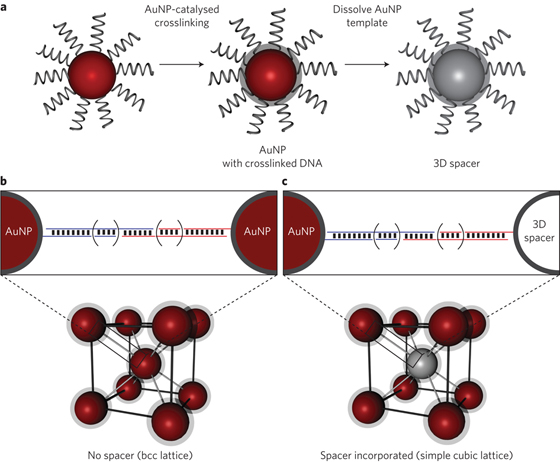
By incorporating the spacer particle - one that had no inorganic core - in place of the gold nanoparticle, the researchers were able to transform the structure of a body-centred cubic lattice to a simple cubic lattice. They extended this technique to other binary lattices and were able to synthesise many exotic lattices, including one which has no natural or synthetic equivalent for any known material.
"Using these dummy particles gives us access to an entirely new design space," Auyeung said. "The next step is to study the kind of properties that these lattices have thanks to the different arrangement of the nanoparticles. If we can fully investigate this design space, we might be able to access some new emergent properties from these materials."
The work was supported by the US Department of Energy's basic energy siences program.
The results of the research were published in the January issue of Nature Nanotechnology.