Starlink widens lead as airlines race to upgrade in-flight Wi-Fi
By Cygnus | 09 Jun 2026
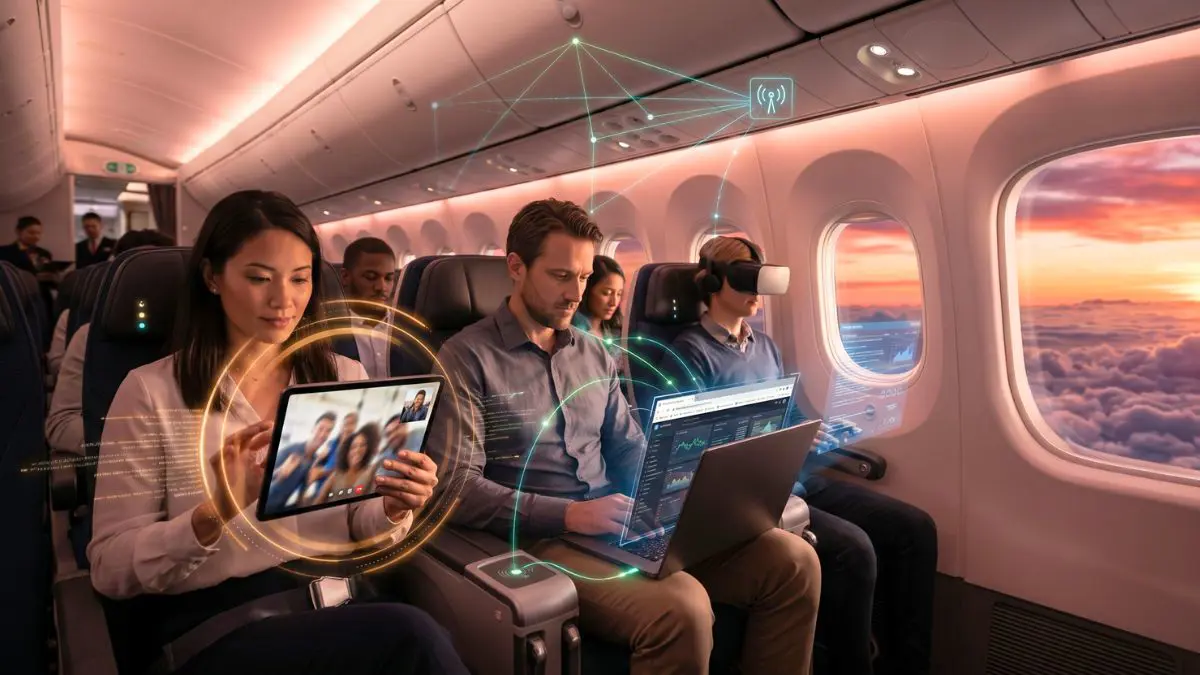
Summary
Airlines are increasingly treating high-speed in-flight Wi-Fi as a premium service essential for attracting customers and boosting revenue, fueling competition between SpaceX’s Starlink and Amazon’s Project Kuiper satellite network.
Starlink has established an early lead in the aviation connectivity market, while Amazon is pursuing airline partnerships as it expands its low-Earth-orbit satellite infrastructure.
RIO DE JANEIRO, June 9, 2026 — The race to deliver faster and more reliable in-flight internet is accelerating as airlines worldwide invest heavily in connectivity upgrades, creating growing competition between SpaceX’s Starlink network and Amazon’s Project Kuiper satellite broadband service.
As airlines seek to attract premium travelers and strengthen customer loyalty, onboard Wi-Fi is increasingly shifting from an optional paid service to a core component of the passenger experience.
According to aviation intelligence firm Valour Consultancy, Starlink has signed 11 new airline customers globally so far in 2026, following 22 additions in 2025, eight in 2024 and three in 2022. The figures underscore the rapid adoption of low-Earth-orbit satellite broadband across commercial aviation.
Amazon, meanwhile, is still expanding its Project Kuiper constellation as it seeks to challenge Starlink’s early market lead. The company has secured initial aviation customers through agreements with Delta Air Lines and JetBlue Airways, positioning itself for future growth in the sector.
Industry experts say airlines are increasingly willing to make substantial investments in connectivity systems as they focus on premium services to improve profitability and customer retention.
Decius Valmorbida, president of travel at Amadeus, described advanced in-flight connectivity as a transformative technology that is quickly becoming a necessity across the airline industry.
“It’s going to become a necessity that every airline will rush to have its own version of,” Valmorbida said.
Starlink’s growth has been driven by its network of thousands of low-Earth-orbit satellites, which generally provide faster internet speeds and lower latency than traditional geostationary satellite systems.
The technology has attracted interest from major airlines. Southwest Airlines said it selected Starlink partly because of its ability to accelerate deployment timelines, although the carrier has indicated it remains open to evaluating alternative connectivity providers in the future.
In late May, American Airlines announced plans to equip more than 500 narrowbody aircraft with Starlink beginning in the first quarter of 2027, further expanding the provider’s aviation footprint.
High costs create barriers but demand remains strong
Upgrading aircraft with next-generation satellite broadband requires significant investment, particularly for large airline fleets.
Analysts at Jefferies estimate that American Airlines’ planned Starlink deployment could cost between $150 million and $250 million in equipment and installation expenses alone, excluding recurring annual service fees that could exceed $60 million.
Not all airlines are convinced of the business case. Ryanair has ruled out adopting Starlink, with Chief Executive Michael O’Leary citing concerns about equipment costs and additional fuel consumption linked to satellite antennas.
Industry analysts expect competition between Starlink and Project Kuiper to intensify over the coming years as more carriers modernize onboard connectivity systems.
Lluc Palerm, research director at Analysys Mason, said airline Wi-Fi is likely to become a major battleground between the two providers, although Amazon remains at an earlier stage of deployment.
Valour Consultancy estimates that Starlink currently holds contracts covering more than 7,000 aircraft worldwide, giving it a significant advantage in market scale and customer adoption.
Analysts also note that switching providers can be difficult because aircraft must be removed from service for equipment installation, hardware is provider-specific, and airline contracts typically span several years.
Connectivity becomes a strategic revenue driver
For airlines, fast Wi-Fi is increasingly about more than passenger convenience. Enhanced connectivity enables carriers to strengthen loyalty programmes, promote ancillary services and maintain customer engagement beyond the flight itself.
A 2025 study published in the Journal of Air Transport Management found that Wi-Fi availability was associated with increased passenger share on the routes examined.
Southwest Airlines expects its first Starlink-equipped aircraft to enter service later this month and aims to complete more than 300 aircraft conversions by the end of the year. Access to the free high-speed tier will be tied to membership in Southwest’s Rapid Rewards loyalty programme.
Delta Air Lines has reported that more than 163 million SkyMiles members have used its complimentary Wi-Fi service since 2023, demonstrating how onboard connectivity can support customer engagement initiatives. The airline plans to begin installations of Project Kuiper hardware on an initial 500 aircraft starting in 2028.
Meanwhile, United Airlines said free Starlink Wi-Fi for MileagePlus members is active on more than 25% of its daily departures, representing roughly 1,200 flights per day, with full fleet deployment expected by the end of 2027.
As passenger expectations continue to evolve, airlines are increasingly viewing high-speed internet access as a competitive differentiator capable of influencing booking decisions and strengthening long-term customer loyalty.
Why this matters
- Premium differentiation: In-flight Wi-Fi is evolving from a luxury amenity into a key factor influencing airline choice and customer satisfaction.
- First-mover advantage: Starlink has established a substantial lead in aviation connectivity through rapid deployment and broad airline adoption.
- Loyalty programme growth: Airlines are using free high-speed connectivity to drive enrolment and engagement in loyalty ecosystems.
- Competitive pressure: Project Kuiper’s entry is expected to intensify competition and accelerate innovation in satellite-based aviation broadband.
- Long-term commitments: Significant installation costs and multi-year contracts make connectivity decisions strategically important for airlines.
FAQs
Q1: Why are airlines upgrading their in-flight Wi-Fi services?
Airlines are investing in faster connectivity to attract premium travelers, improve passenger satisfaction, strengthen loyalty programmes and generate additional revenue opportunities.
Q2: What advantage does Starlink have in the aviation market?
Starlink’s extensive low-Earth-orbit satellite constellation enables high-speed internet with lower latency than traditional geostationary satellite systems, while its early market entry has helped secure numerous airline contracts.
Q3: Which major U.S. airlines have committed to Starlink?
United Airlines, Southwest Airlines and American Airlines have announced significant Starlink deployment plans across their fleets.
Q4: How is Amazon competing in airline connectivity?
Amazon is expanding Project Kuiper and has secured agreements with Delta Air Lines and JetBlue Airways as it seeks to establish a foothold in the aviation connectivity market.
Q5: Why is switching connectivity providers difficult for airlines?
Changing providers typically requires aircraft downtime for hardware installation, provider-specific equipment changes and adjustments to long-term service agreements.