Mucus is retained in cystic fibrosis patients’ cells, leads to potentially deadly infections
24 Feb 2015
Cystic fibrosis is a genetic disorder that affects one out of every 3,000 children in populations of Northern European descent.
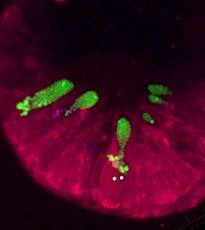 | |
| This image shows the difference in levels of acidity between the mucus, in green, and the rest of the cell |
One of the key signs of cystic fibrosis is that mucus lining the lungs, pancreas and other organs is too sticky, which makes it difficult for the organs to work properly and, in the lungs, attracts bacteria and viruses resulting in chronic infections.
Researchers at the University of Missouri recently found that cystic fibrosis mucus actually gets stuck inside some of the cells that create it, rather than simply becoming stuck on the outside linings of organs.
Lane Clarke, a professor of biomedical sciences in the MU College of Veterinary Medicine, says that now that it is better understood how mucus becomes trapped in the body, scientists can begin working on potential treatments for patients with cystic fibrosis that help cells remove the sticky mucus more quickly.
''Normally, special cells create mucus and easily push it out to the linings of the organs where it belongs,'' said Clarke, who also is a Dalton Investigator in the MU Dalton Cardiovascular Research Center.
''However, in cystic fibrosis patients, some cells that create the mucus fail to completely release the mucus, so the mucus becomes stuck halfway in and halfway out. This makes mucus clearance more difficult and potentially would allow bacteria to have an easy pathway to infecting cells to cause diseases like pneumonia.''
Clarke also examined the characteristics of mucous stored within the cells and found that it is not as acidic as in normal cells.
''Previously, cystic fibrosis researchers disagreed as to whether cystic fibrosis cells also have a defect in properly acidifying areas inside cells,'' Clarke said. ''Finding that cystic fibrosis mucus granules are not acidic is important because the lack of acidity slows the release of products from other secreting cells. Knowing this will allow us to begin further investigation into what causes this lack of acidity, which could eventually be another pathway to developing treatments for this disease.''
This study was published in the Journal of Clinical Investigation.

























