Robotic roach gets wings, sheds light on evolution of flight
19 Oct 2011
1
When engineers at the University of California, Berkeley, outfitted a six-legged robotic bug with wings in an effort to improve its mobility, they unexpectedly shed some light on the evolution of flight.
 Even though the wings significantly improved the running performance of the 10-centimetre-long robot - called DASH, short for 'dynamic autonomous sprawled hexapod' - they found that the extra boost would not have generated enough speed to launch the critter from the ground. The wing flapping also enhanced the aerial performance of the robot, consistent with the hypothesis that flight originated in gliding tree-dwellers.
The research team, led by Ron Fearing, professor of electrical engineering and head of the Biomimetic Millisystems Lab at UC Berkeley, reports its conclusions online Tuesday, October 18, in the peer-reviewed journal Bioinspiration and Biomimetics.
Using robot models could play a useful role in studying the origins of flight, particularly since fossil evidence is so limited, the researchers noted.
First unveiled by Fearing and graduate student Paul Birkmeyer in 2009, DASH is a lightweight, speedy robot made of inexpensive, off-the-shelf materials, including compliant fiber board with legs driven by a battery-powered motor. Its small size makes it a candidate for deployment in areas too cramped or dangerous for humans to enter, such as collapsed buildings.
But compared with its biological inspiration, the cockroach, DASH had certain limitations as to where it could scamper. Remaining stable while going over obstacles is fairly tricky for small robots, so the researchers affixed DASH with lateral and tail wings borrowed from a store-bought toy to see if that would help.
''Our overall goal is to give our robots the same all-terrain capabilities that other animals have,'' said Fearing. ''In the real world, there will be situations where flying is a better option than crawling, and other places where flying won't work, such as in confined or crowded spaces. We needed a hybrid running-and-flying robot.''
The researchers ran tests on four different configurations of the robotic roach, now called DASH+Wings. The test robots included one with a tail only and another that just had the wing's frames, to determine how the wings impacted locomotion.
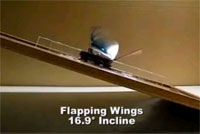
With its motorised flapping wings, DASH+Wings' running speed nearly doubled, going from from 0.68 metres per second with legs alone to 1.29 metres per second. The robot could also take on steeper hills, going from an incline angle of 5.6 degrees to 16.9 degrees.
''With wings, we saw improvements in performance almost immediately,'' said study lead author Kevin Peterson, a PhD student in Fearing's lab. ''Not only did the wings make the robot faster and better at steeper inclines, it could now keep itself upright when descending. The wingless version of DASH could survive falls from eight stories tall, but it would sometimes land upside down, and where it landed was partly guided by luck.''
The flapping wings improved the lift-drag ratio, helping DASH+Wings land on its feet instead of just plummeting uncontrolled. Once it hit the ground, the robot was able to continue on its way. Wind tunnel experiments showed that it is aerodynamically capable of gliding at an angle up to 24.7 degrees.
The engineering team's work caught the attention of animal flight expert Robert Dudley, a UC Berkeley professor of integrative biology, who noted that the most dominant theories on flight evolution have been primarily derived from scant fossil records and theoretical modelling.
He referenced previous computer models suggesting that ground-dwellers, given the right conditions, would need only to triple their running speed in order to build up enough thrust for takeoff. The fact that DASH+Wings could maximally muster a doubling of its running speed suggests that wings do not provide enough of a boost to launch an animal from the ground. This finding is consistent with the theory that flight arose from animals that glided downwards from some height.
''The fossil evidence we do have suggests that the precursors to early birds had long feathers on all four limbs, and a long tail similarly endowed with a lot of feathers, which would mechanically be more beneficial for tree-dwelling gliders than for runners on the ground,'' said Dudley.
Even though the wings significantly improved the running performance of the 10-centimetre-long robot - called DASH, short for 'dynamic autonomous sprawled hexapod' - they found that the extra boost would not have generated enough speed to launch the critter from the ground. The wing flapping also enhanced the aerial performance of the robot, consistent with the hypothesis that flight originated in gliding tree-dwellers.The research team, led by Ron Fearing, professor of electrical engineering and head of the Biomimetic Millisystems Lab at UC Berkeley, reports its conclusions online Tuesday, October 18, in the peer-reviewed journal Bioinspiration and Biomimetics.
Using robot models could play a useful role in studying the origins of flight, particularly since fossil evidence is so limited, the researchers noted.
First unveiled by Fearing and graduate student Paul Birkmeyer in 2009, DASH is a lightweight, speedy robot made of inexpensive, off-the-shelf materials, including compliant fiber board with legs driven by a battery-powered motor. Its small size makes it a candidate for deployment in areas too cramped or dangerous for humans to enter, such as collapsed buildings.
But compared with its biological inspiration, the cockroach, DASH had certain limitations as to where it could scamper. Remaining stable while going over obstacles is fairly tricky for small robots, so the researchers affixed DASH with lateral and tail wings borrowed from a store-bought toy to see if that would help.
''Our overall goal is to give our robots the same all-terrain capabilities that other animals have,'' said Fearing. ''In the real world, there will be situations where flying is a better option than crawling, and other places where flying won't work, such as in confined or crowded spaces. We needed a hybrid running-and-flying robot.''
The researchers ran tests on four different configurations of the robotic roach, now called DASH+Wings. The test robots included one with a tail only and another that just had the wing's frames, to determine how the wings impacted locomotion.
With its motorised flapping wings, DASH+Wings' running speed nearly doubled, going from from 0.68 metres per second with legs alone to 1.29 metres per second. The robot could also take on steeper hills, going from an incline angle of 5.6 degrees to 16.9 degrees.
''With wings, we saw improvements in performance almost immediately,'' said study lead author Kevin Peterson, a PhD student in Fearing's lab. ''Not only did the wings make the robot faster and better at steeper inclines, it could now keep itself upright when descending. The wingless version of DASH could survive falls from eight stories tall, but it would sometimes land upside down, and where it landed was partly guided by luck.''
The flapping wings improved the lift-drag ratio, helping DASH+Wings land on its feet instead of just plummeting uncontrolled. Once it hit the ground, the robot was able to continue on its way. Wind tunnel experiments showed that it is aerodynamically capable of gliding at an angle up to 24.7 degrees.
The engineering team's work caught the attention of animal flight expert Robert Dudley, a UC Berkeley professor of integrative biology, who noted that the most dominant theories on flight evolution have been primarily derived from scant fossil records and theoretical modelling.
He referenced previous computer models suggesting that ground-dwellers, given the right conditions, would need only to triple their running speed in order to build up enough thrust for takeoff. The fact that DASH+Wings could maximally muster a doubling of its running speed suggests that wings do not provide enough of a boost to launch an animal from the ground. This finding is consistent with the theory that flight arose from animals that glided downwards from some height.
''The fossil evidence we do have suggests that the precursors to early birds had long feathers on all four limbs, and a long tail similarly endowed with a lot of feathers, which would mechanically be more beneficial for tree-dwelling gliders than for runners on the ground,'' said Dudley.