Researchers demonstrate record-setting p-type transistor
By By Larry Hardesty, MIT News Office | 04 Jan 2013
Almost all computer chips use two types of transistors: one called p-type, for positive, and one called n-type, for negative. Improving the performance of the chip as a whole requires parallel improvements in both types.
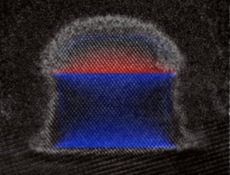 |
| In this micrograph of an experimental transistor, blue highlighting indicates areas of "strain," where germanium atoms have been forced closer together than they find comfortable. One of the reasons for the transistor's record-setting performance is that the strain has been relaxed in the lateral direction. Image: Winston Chern and James Teherani |
At the IEEE's International Electron Devices Meeting (IEDM) in December, researchers from MIT's Microsystems Technology Laboratories (MTL) presented a p-type transistor with the highest ''carrier mobility'' yet measured. By that standard, the device is twice as fast as previous experimental p-type transistors and almost four times as fast as the best commercial p-type transistors.
Like other experimental high-performance transistors, the new device derives its speed from its use of a material other than silicon: in this case, germanium. Alloys of germanium are already found in commercial chips, so germanium transistors could be easier to integrate into existing chip-manufacturing processes than transistors made from more exotic materials.
The new transistor also features what's called a trigate design, which could solve some of the problems that plague computer circuits at extremely small sizes (and which Intel has already introduced in its most advanced chip lines). For all these reasons, the new device offers a tantalising path forward for the microchip industry - one that could help sustain the rapid increases in computing power, known as Moore's Law, that consumers have come to expect.
Pluses and minuses
A transistor is basically a switch - In one position, it allows charged particles to flow through it; in the other position, it doesn't. In an n-type transistor, the particles - or charge carriers - are electrons, and their flow produces an ordinary electrical current.
In a p-type transistor, on the other hand, the charge carriers are positively charged ''holes.'' A p-type semiconductor doesn't have enough electrons to balance out the positive charges of its atoms; as electrons hop back and forth between atoms, trying futilely to keep them electrically balanced, holes flow through the semiconductor, in much the way waves propagate across water molecules that locally move back and forth by very small distances.

























