38 per cent of internet users use the net for 8.2 hours per week
17 Oct 2006
Mumbai: Around 38 per cent of all internet users in India are 'heavy users' and on an average spend about 8.2 hours per week on the internet, according to the I-Cube 2006 report by the Internet And Mobile Association of India (IAMAI) and IMRB International.
The report also revealed that the percentage of heavy internet users in India is rapidly increasing - from 16 per cent in 2001, to 20 per cent in 2004 and now to 38 per cent in 2006. Similarly, the percentage of light internet users has steadily declined from 63 per cent in 2001 to 28 per cent in 2006.
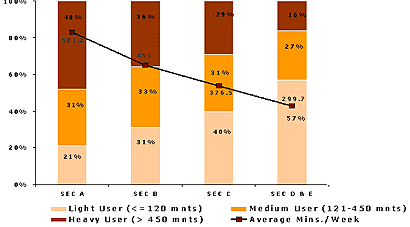
The study further states that school going kids spend an average of 322.3 minutes a week on the internet while those in college spend an average of 433.2 minutes a week. Older men spend an average of 580.5 minutes a week And among them working women spend an average 535.3 minutes, while the non-working women spend 334.5 minutes a week.
| Fast facts Avg mins/week:
| ||||||||||||||||||||||||

Explaining the trend towards rising internet usage in India, Dr Subho Ray, president, IAMAI, says, "The study has confirmed what we have believed for some time now consumers spend more time on the net than on any other media. This is food for thought for advertisers and media buyers."
The study also established that the average time spent on the internet in terms of minutes per week increased with the increasing age of the user. The active internet users exhibit a marked increase in internet usage as they graduate from school to college, and then onto their professional lives. The internet has surely stamped its presence in the urban Indian landscape.
Mohan Krishnan, vice president and general manager, IMRB International, says, "This trend is of great relevance. It leads us to the assumption that the internet has now penetrated beyond the communication needs of the active user population and is no longer an avenue for exploring their curiosity. The active user population has found greater and diverse uses beyond communication and this is where the opportunity lies for far greater growth and adoption.."
I-Cube 2006 covered around 65,000 individuals from 16,500 households surveyed in 26 cities with an additional coverage of 10,000 businesses and 250 cyber cafeé owners and is one the largest offline surveys of internet users in India.
| Base*: | 3.1 million | 4.9 million | 7.5 million | 13.2 million |
| Avg. Hrs/Week | 5.5 | 4.8 | 6.1 | 8.2 |
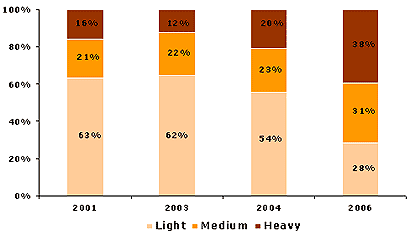
*- Active Users in the cities covered in the survey (26 cities in 2006)
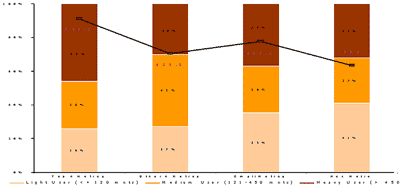
* - Active net users in the cities covered in the survey (26 cities in 2006)
| Top 4 Metros: | Delhi, Mumbai, Chennai, Kolkatta |
| Other 4 Metros: | Bangalore, Hyderabad, Ahmedabad, Pu |
| Small Metros: | Patna, Cochin, Baroda, Lucknow, Ludhiana, Coimbatore, Jaipur, Indore, Bhopal, Vishakhapatnam |
| Non Metros: | Chandigarh, Bhubaneswar, Durg, Allahabad, Trichy, Guwhati |
| Base: | 6.1 million | 3.9 million | 2.9 million | 0.3 million |
Latest articles








Featured articles

Server CPU Shortages Grip China as AI Boom Strains Intel and AMD Supply Chains
By Cygnus | 06 Feb 2026
Intel and AMD server CPU shortages are hitting China as AI data center demand surges, pushing lead times to six months and driving prices higher.

Budget 2026-27 Seeks Fiscal Balance Amid Rupee Volatility and Industrial Stagnation
By Cygnus | 02 Feb 2026
India's Budget 2026-27 targets fiscal discipline with record capex as markets tumble, the rupee weakens and manufacturing struggles to regain momentum.

The Thirsty Cloud: Why 2026 Is the Year AI Bottlenecks Shift From Chips to Water
By Axel Miller | 28 Jan 2026
As AI server density surges in 2026, data centers face a new bottleneck deeper than chips — the massive water demand required for cooling next-generation infrastructure.

The New Airspace Economy: How Geopolitics Is Rewriting Aviation Costs in 2026
By Axel Miller | 22 Jan 2026
Airspace bans, sanctions and corridor risk are forcing airlines into costly detours in 2026, raising fuel burn, reducing aircraft utilisation and pushing airfares higher worldwide.

India’s Data Center Arms Race: The Battle for Power, Cooling, and AI Real Estate
By Cygnus | 22 Jan 2026
India’s data centre boom is turning into an AI arms race where power contracts, liquid cooling and fast commissioning decide the winners across Mumbai, Chennai and Hyderabad.

India’s Oil Balancing Act: Refiners Rebuild Middle East Supply Lines as Russia Flows Disrupt
By Axel Miller | 21 Jan 2026
India’s refiners are rebalancing crude sourcing as Russian imports fell to a two-year low in December 2025, lifting OPEC’s share and raising geopolitical risk concerns.

Arctic Fever: How ‘Greenland Tariff’ Politics Sparked a Global Flight to Safety
By Axel Miller | 20 Jan 2026
Greenland-linked tariff threats have injected fresh uncertainty into transatlantic trade, triggering a risk-off shift in markets and reshaping global supply chain planning.

The New Oil (Part 5): Friend-Shoring, Supply Chain Fragmentation and the Cost of Resilience
By Cygnus | 19 Jan 2026
Friend-shoring is reshaping lithium, rare earth and graphite supply chains, creating a resilience premium and new winners and losers in clean tech.

The New Oil (Part 4): Can Technology Break the Dependency?
By Cygnus | 16 Jan 2026
Can magnet recycling and rare-earth-free motors reduce global dependence on strategic minerals? Part 4 explores breakthroughs, limits and timelines.

Latest articles





