Designer blood clots: artificial platelets could treat battlefield injuries
16 Feb 2013
When it comes to healing the terrible wounds of war, success may hinge on the first blood clot – the one that begins forming on the battlefield right after an injury.
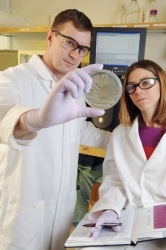 Researchers exploring the complex stream of cellular signals produced by the body in response to a traumatic injury believe the initial response – formation of a blood clot – may control subsequent healing. Using that information, they're developing new biomaterials, including artificial blood platelets laced with regulatory chemicals that could be included in an injector device the size of an iPhone. Soldiers wounded in action could use the device to treat themselves, helping control bleeding, stabilising the injury and setting the right course for healing.
Formation of ''designer'' blood clots from the artificial platelets would be triggered by the same factor that initiates the body's natural clotting processes. In animal models, the synthetic platelets reduced clotting time by approximately 30 per cent, though the materials have not yet been tested in humans.
''The idea is to have on the battlefield technologies that would deliver a biomaterial capable of finding where the bleeding is happening and augmenting the body's own clotting processes,'' said Thomas Barker, an associate professor in the Wallace H. Coulter Department of Biomedical Engineering at Georgia Tech and Emory University. ''Simultaneously, the material would help instruct the biochemistry and biophysics of the clot structure that would govern subsequent healing.''
Barker presented information on the research Friday, 15 February the annual meeting of the American Association for the Advancement of Science (AAAS). The research has been sponsored in part by the National Institutes of Health (NIH), by the US Department of Defense through the Center for Advanced Bioengineering for Soldier Survivability at Georgia Tech, and by an American Heart Association postdoctoral fellowship to Ashley Brown, a postdoctoral fellow working on the project.
After an injury, the most critical need is to stop the bleeding. But as traumatic injuries heal, they often produce significant scarring that is difficult to treat. Georgia Tech researchers are working on both sides of the problem, developing cell signalling techniques that may head off the formation of scars – as well as techniques for addressing the fibrosis that is often the long-term result. Beyond helping halt the bleeding, the synthetic platelets would deliver regulatory chemicals designed to prevent scarring.

























