Strategic Oil Buffers: India Accelerates SPR Expansion Amid Global Supply Risks
By Cygnus | 09 Apr 2026
Summary
- India is advancing Phase-II of its Strategic Petroleum Reserve (SPR) to expand capacity from 5.33 MMT to 11.83 MMT.
- Current reserves are estimated at roughly two-thirds full, providing about 9–10 days of import cover.
- Global coordination is underway, with the International Energy Agency leading a large-scale release of emergency oil stocks to stabilize markets.
NEW DELHI, April 9, 2026 — India is accelerating efforts to strengthen its energy security as global oil supply risks persist amid ongoing tensions in West Asia. The government is pushing forward with the next phase of its Strategic Petroleum Reserve (SPR) program, aligning with broader international measures to cushion economies from volatility in crude markets.
India’s Defensive Buffer
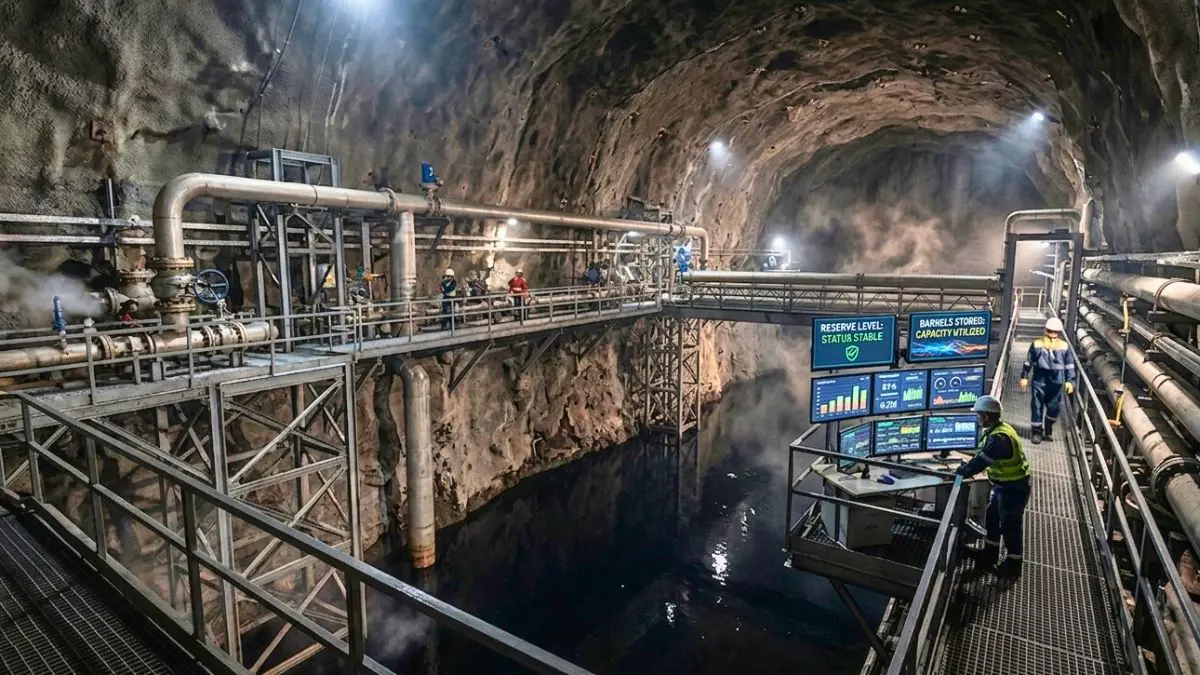
India’s existing SPR capacity stands at 5.33 million metric tonnes (MMT), stored across underground facilities at Visakhapatnam, Mangaluru, and Padur. Government updates indicate that these reserves are currently around two-thirds full, translating to roughly 9–10 days of net import cover.
To enhance resilience, India is moving ahead with Phase-II expansion, which will add 6.5 MMT of capacity through new facilities at Chandikhol and Padur. Once completed, total capacity will rise to 11.83 MMT, helping narrow the gap with global energy security benchmarks.
Global Context: Coordinated Stockpile Strategy
Major economies are simultaneously deploying or managing reserves to address supply disruptions:
- United States: Maintaining strategic reserves above 400 million barrels, with calibrated releases to stabilize domestic markets.
- China: Holding over 1 billion barrels across strategic and commercial storage, providing significant buffer capacity.
- Japan: Maintaining one of the highest cover levels globally, supported by both public and private reserves.
The International Energy Agency has coordinated one of the largest collective responses in recent years, encouraging member and partner countries to release stocks in order to ease global supply pressures.
Expanding Through Public-Private Participation
India is also evolving its SPR model by incorporating public-private partnerships (PPP) in Phase-II projects. This “commercial-cum-strategic” framework allows private players to utilize storage capacity while ensuring that the government retains priority access during emergencies.
This approach is expected to improve utilization efficiency while reducing the fiscal burden of maintaining large reserves.
Why This Matters
- Energy Security: Expanded reserves provide a buffer against geopolitical disruptions and supply shocks.
- Inflation Management: Strategic releases can help moderate domestic fuel price spikes.
- Market Stability: Coordinated global stockpile actions remain one of the few immediate tools to counter sharp oil price volatility.
FAQs
Q1. Is India’s current reserve level sufficient?
Not fully. While the existing reserves provide short-term protection, they fall well below the ~90-day cover recommended by the International Energy Agency, making expansion critical.
Q2. How does India compare with China and Japan?
China and Japan maintain significantly higher coverage levels due to earlier investments and larger storage infrastructure, giving them a stronger buffer against disruptions.
Q3. What is Phase-II of India’s SPR?
It is the next stage of expansion that includes new storage sites in Chandikhol and Padur, aimed at nearly doubling current capacity.

























