A lukewarm budget for the textile sector
28 Feb 2007
Budget 2007-08 was lukewarm for the textiles sector. Announcing sops for the sector, finance minister, P Chidambaram said that the rejuvenated textile industry is geared to meet the global challenge.
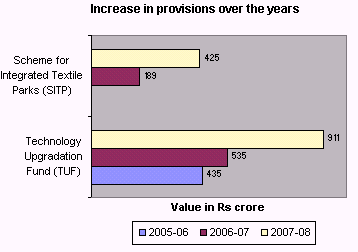
He said that under the scheme for integrated textiles parks (SITP), 26 of the sanctioned 30 parks have been approved and announced to increase the provision for these parks from Rs189 crore in 2006-07 to Rs425 crore in 2007-08.
The ''technology upgradation fund'' is to be continued under the eleventh plan and will cover handlooms also. The TUF allocation will be increased from Rs535 crore in 2007-07 to Rs911 crore in the coming fiscal year.
The handloom sector will see an additional 100-150 clusters. The health insurance covering 3 lakh weavers will be extended to more weavers and would include ancillary workers also. Chidambaram proposed to enhance the allocation for the sector from Rs241 crore in 2006-07 to Rs321 crore in 2007-08.
Taking the measures for man made fibres and yarns forward from last year, custom duty on polyester fibres and yarns has been reduced from 10 per cent to 7.5 per cent. Custom duty for important raw materials such as dimethyl terephthalate (DMT), purified terephthalic acid (PTA), mono ethylene glycol (MEG) has been reduced from 10 per cent to 7.5 per cent.
Reacting
to the Budget, Sunil Gupta, director, Gupta Synthetics
said, "The Union Budget is lackluster. It has no
special benefits for the synthetic yarn industry and
demands of the industry have been ignored."
Latest articles








Featured articles

The decoupling paradox: Why Wall Street keeps funding AI despite $100 oil
By Axel Miller | 11 May 2026
AI infrastructure stocks continue rallying despite $100 oil as investors bet on productivity gains and semiconductor demand in 2026.

Hybrid bonding gains attention as AI chip packaging demand grows
By Cygnus | 23 Apr 2026
Hybrid bonding is driving AI chip packaging demand as backend technologies gain importance in the semiconductor supply chain.

The agentic transition: how enterprises are scaling AI from pilot to profit
By Cygnus | 22 Apr 2026
AI has entered its execution era. Discover how companies like Valeo and Microsoft are scaling agentic AI systems—from copilots to autonomous workflows driving real business impact.

Post-splashdown: What Artemis II taught us about the ‘deep space wall’
By Axel Miller | 15 Apr 2026
Artemis II splashdown marks a breakthrough in deep space exploration. Discover AVATAR radiation data, Orion’s distance record, and insights shaping NASA’s 2028 Moon mission.

Can aviation go green? The multi-billion dollar race for sustainable fuel
By Cygnus | 10 Apr 2026
Airlines are racing to adopt sustainable aviation fuel, but limited supply and high costs challenge the future of green aviation.

The battery race: who will control the future of electric vehicles?
By Axel Miller | 08 Apr 2026
The global battery race is reshaping the electric vehicle industry, with China, the US, and Europe competing for control over supply chains and technology.

AI vs governments: Who controls the future of intelligence?
By Cygnus | 07 Apr 2026
Governments and AI companies like OpenAI and Anthropic are shaping the future of intelligence amid rising policy conflicts and global competition.

Strait of Hormuz: how one chokepoint controls the global economy
By Axel Miller | 06 Apr 2026
The Strait of Hormuz is a critical global chokepoint. Learn how disruptions impact oil prices, shipping, and the global economy.

The $2 trillion AI infrastructure race: Who will control global compute?
By Cygnus | 06 Apr 2026
AI spending is set to exceed $2 trillion in 2026, driving a global race in data centers, chips, and energy infrastructure.


Latest articles





